Bangladesh Perspective
The power sector forms the backbone of any developing economy, and the transmission grid is the bridge connecting electricity generators to end consumers. However, in South Asia, state-owned power transmission companies face severe operational and institutional crises. A primary example of this distress is Power Grid Bangladesh PLC (PGCB), established in 1997. It is a state-owned enterprise that has incurred recurring operating losses over several fiscal years. The company’s accumulated losses have surpassed Tk 1,500 crore, while its total debt burden has grown to nearly Tk 60,000 crore, as of May 2026. This huge debt accrual is driven by the execution of several large infrastructure initiatives worth Tk 74,000 crore. PGCB has formally stated its inability to repay loans obtained from international financial institutions. The crisis is deteriorating due to rising administrative expenses, massive interest on loans, and substantial foreign exchange conversion losses (over Tk 3,000 crore) resulting from the devaluation of the local currency.
The primary cause behind this structural failure is the severe gap between planned electricity transmission and actual grid utilization. PGCB expanded its network infrastructure to a total transmission capacity of 30,000MW. However, a major portion of this capacity remains unutilized due to lower generation volumes. It forces the company to spend massive sums on maintaining idle infrastructure and a large workforce. This mismatch is further intensified by generation deficiencies within the state-owned power system. Publicly owned gas and coal-fired plants fail to maintain regular generation. Often, it is forced to bring in electrical power from far-flung private power producers. Such long distances heavily increase transmission system losses (3.31% in May 2026) and create significant voltage instability. To survive, the company has submitted a proposal to the national regulatory body to increase its wheeling charges (ie, cost of using and maintaining the electric grid/transmission and distribution lines to the consumer) by over 50% across various voltage levels (for 230 kV: tariff Tk 0.3057 to Tk 0.4831/kWh, for 132 kV: tariff Tk 0.3086 to Tk 0.4877/kWh, for 33 kV: tariff Tk 0.3144 to TK 0.4969/kWh). However, the experts warn that addressing these losses by raising transmission tariffs will ultimately increase the total generation cost of electricity, causing inflation and additional financial stress for retail consumers.
Case Study 1: Pakistan, National Grid Company (NGC)
A similar pattern of financial distress and structural vulnerability can be observed in Pakistan, which directly threatens national development. Here, the NGC Limited of Pakistan (former National Transmission and Dispatch Company- NTDC) handles primary electricity transmissionfor managing the bulk high-voltages (220 kV, 500 kV,and above).
The core problem in Pakistan is circular debt, which paralyzes the entire energy supply chain. NGC struggles with poor revenue collection and fails to meet the targets for transmission and distribution losses. The distribution entity defaults on payments to the central power purchasing agency. Therefore, the transmission utility faces a severe cash crunch, leaving it without the necessary capital to upgrade its outdated network. On a standalone basis, NGC's tariff structure is designed for full cost recovery, and it manages to pull a net profit after tax, reporting a revenue of PKR (Pakistan Rupee) 53,076 million for 9 months in FY (fiscal year) 2025. However, the company faces an acute liquidity and structural loss crisis due to severe technical constraints, aging infrastructure, and South-North transmission bottlenecks. These issues resulted in a massive national system loss of PKR 60.39 billion (US$ 216 million) during FY 2023-24 alone, as cheaper power had to be curtailed in favor of expensive local generation. The legacy of Pakistan's energy circular debt heavily penalizes the grid, and up until recently. The National Electric Power Regulatory Authority (NEPRA) had withheld PKR 41.44 billion in dues from NGC's system charges over economic merit order violations. This heavily impairs its working capital and delays vital grid infrastructure projects.
Pakistan's transmission infrastructure consists of tens of thousands of kilometers of lines. Yet, it suffers from massive system losses and frequent blackouts. Because the government historically sets consumer tariffs well below the actual cost of supply, the entire network relies on heavy state subsidies. Delays in releasing these subsidies trigger a chain reaction of payment defaults affecting fuel suppliers, private generators, and transmission agencies alike. Furthermore, the mismatch between generation planning and transmission capability is highly visible. Sub-optimal capacity utilization and a heavy reliance on expensive imported fuel oil have caused generation costs to skyrocket. This operational inefficiency costs Pakistan’s economy an estimated 2% of its gross domestic product (GDP) annually. Due to inadequate investment and bureaucratic delays in upgrading transmission corridors, the grid cannot reliably handle peak loads, forcing industries to set up expensive private backup generators. The state transmission entity, i.e., NGC, remains financially crippled, dependent on periodic government bailouts. It is unable to achieve financial sustainability because its revenue model is broken by system-wide collection failures.
Case Study 2: Sri Lanka, Ceylon Electricity Board (CEB)
In Sri Lanka, the transmission system is managed by the CEB, a vertically integrated state utility that faces comparable systemic failures. Under the newly enacted Sri Lanka Electricity Act, it is being unbundled into separate state-owned entities, with its high-voltage transmission and system operations remaining under state control. Sri Lanka’s geographical isolation as an island means its electrical grid cannot import or export power from the wider South Asian subcontinent. Therefore, ensuring grid stability and infrastructure utilization is incredibly sensitive. Historically, CEB has suffered from massive financial deficits caused by bad political management and rigid pricing frameworks. Still, it remains under severe fiscal strain, despite aggressive electricity tariff revisions implemented throughout 2024-25 to align with actual generation costs. High generation costs driven by an expensive reliance on thermal power during dry quarters have offset tariff revenue. According to the Central Bank of Sri Lanka's Annual Economic Review, the CEB recorded a total financial loss of LKR (Sri Lanka Rupee) 38.7 billion (US$ 128 million) for the year 2025. Consequently, its short-term liabilities rose to LKR 206.2 billion.
The Sri Lankan grid relies on a combination of cheaper domestic hydropower and expensive thermal generation run by imported petroleum products. The grid is forced to rely entirely on high-cost thermal power during droughts. It causes the utility's operational costs to shoot up dramatically. CEB has struggled with capacity shortfalls and overstretched medium-voltage transmission and distribution lines. The country succeeded in reducing its overall transmission and distribution losses from much higher levels down to around 14%. Still, the financial model of the utility remains deeply broken. CEB has consistently failed to cover its supply costs through electricity tariffs due to state-enforced consumer subsidies. This lack of financial independence has limited the board’s capacity to execute long-term generation and transmission expansion plans. The utility remains heavily dependent on foreign development assistance and state guarantees to fund its substation augmentations and network expansions. Like Bangladesh, Sri Lanka's power utility faces a severe financial squeeze due to high operational costs and a reliance on imported fuel. Because it cannot independently adjust tariffs, it has accumulated massive debts that place a major fiscal burden on the state.
Case Study 3: India, Power Grid Corporation (POWERGRID)
India presents a slightly different but highly relevant case study through its central transmission utility, named POWERGRID India Ltd. As a Maharatna Public Sector Enterprise under the Ministry of Power, it transmits about 50% of the total electricity generated in India. Unlike its neighbors, the Indian central transmission utility underwent significant structural reforms. That allowed POWERGRID to achieve commercial success and operational efficiency, serving as a valuable lesson for struggling regional utilities.POWERGRID operates under an efficient, regulated return-on-investment model and does not incur financial losses. For the third quarter of the FY 2025-26, the company earns revenue of INR (India Rupee) 12,857.70 crore (US$ 1.54 billion) and a net profit of INR 4,184.96 crore (US$ 500 million), maintaining a net profit margin of over 32%.
Years ago, the Indian power sector faced similar issues to those in Bangladesh, including massive transmission and distribution losses, widespread political interference, and severe financial losses among state-run distribution companies. The central government intervened by unbundling the vertically integrated boards and listing the central transmission entity on the stock exchanges, though the state retained majority ownership. This reform introduced corporate discipline, rigorous project management, and a transparent regulatory framework for tariff determination. Today, POWERGRID manages an extensive network spanning hundreds of kilometers and maintains low transmission system losses of 3-4%. The company’s financial strength allows easy raising of capital from international and domestic markets without relying on subsidies.
However, the Indian transmission network still faces indirect vulnerabilities due to the financial weakness of state-level distribution companies. These state-level utilities often fail to pay transmission charges on time because of low billing efficiency, populist subsidies, and pilferage. To protect POWERGRID from these financial risks, it established strict tripartite payment security mechanisms involving the central bank, state governments, and the central grid operator. Such a system allows the central utility to automatically deduct outstanding dues from a state’s federal revenue share (if it defaults). This regulatory protection demonstrates structural independence, commercial autonomy, and strict payment security to escape losses and heavy debt that currently cripples PGCB.
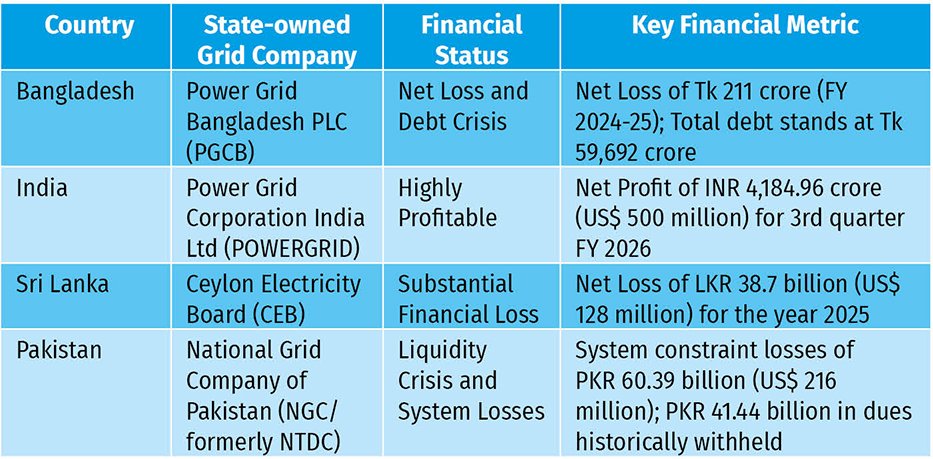
Summary Comparison Table of State-owned Power Grid Companies
Based on the information provided above, the following is a comprehensive summary comparison among Bangladesh, India, Sri Lanka, and Pakistan.
Way Forward for PGCB
The critical lessons those PGCB must learn from these regional peers are that structural unbundling, operational autonomy and disciplined planning are the paths to escape systemic financial failure. The cautionary tales of Pakistan and Sri Lanka demonstrate that relying on state subsidies, allowing a gap between generation and transmission planning and absorbing massive currency risks without hedging mechanisms will inevitably lead to insolvency and unutilized infrastructure capacity. Conversely, the success of India reveals that listing the corporation on public markets, establishing good governance, and implementing legal binding tripartite payment mechanism can insulate the transmission company from wider inefficiency. To move forward and transform into an efficient and profitable enterprise, PGCB must align its future capital expenditure projects with actual, active generation capacities to eliminate idle infrastructure overheads. It must move towards an independent, data-driven tariff model (reflecting operational and debt-servicing costs) without disruptive and ad-hoc wheeling charge spikes. PGCB should also actively hedge its foreign currency debts to protect against local currency devaluation. Furthermore, it should aggressively implement advanced smart-grid technologies to minimize transmission losses, which ultimately secures a stable revenue stream, relieving its massive fiscal burden.
Colonel (Retd) Engineer A R Mohammad Parvez Mazumder, afwc, psc
Download Special Article As PDF/userfiles/EP_24_01_SA_Parvez.pdf