
Hydrocarbon reserves cannot be increased without drilling. Exploration drilling, one of the most expensive and high-risk activities in the petroleum industry, is considered the central part of oil and gas exploration. In reality, drilling is only the final step in a much broader decision-making process. Before a well is drilled, extensive geological, geophysical, engineering, and economic studies must be carried out.
The exploration process usually begins with geoscientists, who identify potential hydrocarbon-bearing structures and evaluate geological uncertainties. This is one of the most important early stages of the drilling process. Reservoir engineers then estimate production potential and possible hydrocarbon recovery. Drilling engineers assess well design, operational feasibility, and technical risks, while petroleum engineers/ economists evaluate project profitability, investment risk, and long-term economic viability.
A drilling decision should therefore be based on integrated technical and economic analysis rather than on a single seismic anomaly or structural feature. It must answer several important questions before drilling:
-
How possible is it that the geological structure can effectively trap and seal hydrocarbons?
-
How likely is the reservoir to have sufficient porosity and permeability for hydrocarbon storage and flow?
-
How effective is the seal in preventing hydrocarbon leakage?
-
Are hydrocarbons likely to have migrated into the trap?
-
What is the geological probability of success?
-
Is the project economically feasible?
- Are there alternative prospects with better investment potential? etc.
Modern seismic technology and risk-analysis tools help exploration teams make better and more transparent drilling decisions. These methods allow experts to compare different possibilities, understand uncertainties, and estimate both technical and financial risks. Instead of relying on assumptions alone, companies can use data-driven analysis to identify the most promising prospects, reduce the chance of costly dry wells, and improve overall exploration planning and management decisions for economic growth.
Importance of Data Analysis
During the early period of petroleum exploration, geoscientists relied on basic seismic interpretation and visible “bright spots” to identify possible hydrocarbons. Due to limited computing and seismic technology, advanced seismic attribute analysis was uncommon. Modern oil and gas exploration now uses advanced computer analysis and seismic evaluation methods to better understand underground conditions, which improves the chances of successful drilling.
Different seismic attributes, which are measurable indicators extracted from seismic data, and Direct Hydrocarbon Indicators (DHIs) are widely used in modern petroleum exploration to identify possible oil and gas accumulations, reservoir quality, and fault systems. However, no single seismic indicator can provide a completely reliable interpretation. Therefore, multiple seismic attributes, DHI responses, and geological models should be carefully integrated and cross-checked before making drilling decisions.
Chance of Success (COS) Evaluation
After identifying the potential presence of hydrocarbons within a geological formation, the next step in petroleum exploration is to evaluate the associated geological risks and uncertainties. Geological Chance of Success (COS) is a fundamental tool used in the risk assessment process to estimate the probability of discovering commercially recoverable hydrocarbons within a prospect.
As illustrated in Figure 1, successful hydrocarbon accumulation depends on the simultaneous occurrence of several independent geological elements within a petroleum system. Failure of any critical element may significantly reduce the probability of exploration success.
The major geological factors considered in COS evaluation include:
Source Rock: Presence of mature source rock capable of generating hydrocarbons (oil and/or gas).
Reservoir: Presence of porous and permeable rock with sufficient storage capacity and fluid transmissibility.
Seal and Trap: Presence of an effective cap rock and structural or stratigraphic trap capable of preventing hydrocarbon leakage.
Migration and Timing: Successful migration of hydrocarbons from the source rock into the reservoir trap at the appropriate geological time.
.jpg)
Figure 1. Simplified geological model illustrating hydrocarbon generation, migration, trapping, reservoir accumulation, and seal configuration within a petroleum system.
The overall COS is commonly estimated by multiplying the probabilities of these independent geological factors:
COS = Psource×Pmigration×Preservoir×Ptrap×Pseal×Ptiming
For example, if the probabilities of source rock presence, hydrocarbon migration, reservoir quality, trap integrity, seal effectiveness, and timing are estimated as 60%, 65%, 90%, 80%, 85%, and 75%, respectively, the resulting overall COS is approximately 18%. In simple terms, the overall chance of success depends on several uncertain geological factors working together. If any one of these critical factors fails or is absent, the exploration well may ultimately fail.
A study conducted by ExxonMobil and published in Benchmarking Exploration Predictions and Performance Using 20+ Years of Drilling Results: One Company’s Experience by Rudolph and Goulding (2017) reported that prospects supported by advanced analytical techniques achieved significantly higher exploration success rates compared to those evaluated without advanced analysis support. The study further indicated that the average exploration drilling Success for these prospects exceeded 72%.
The research also demonstrated that approximately half of exploration failures were associated with trap- and seal-related issues, indicating that these geological uncertainties are among the major contributors to dry-hole risk. In addition, 27% of failure cases were attributed to the absence of effective source rocks or unsuccessful hydrocarbon migration, while nearly 22% of failures occurred due to inadequate reservoir quality, where the rock lacked sufficient porosity to store hydrocarbons effectively.
.jpg)
Figure 2. Major Causes of Exploration Failure in Hydrocarbon Exploration (ExxonMobil, N = 246)
Improved uncertainty analysis can reduce the chance of costly dry holes and save millions of dollars in exploration expenses. The Chance of Success (COS) evaluation should follow a structured and evidence-based approach using standard checklists to ensure that all the key geological factors are assessed. Input from multidisciplinary experts and independent peer reviews is essential for improving reliability and supporting better exploration decisions.
Uncertainty in Reserve Evaluation
While the Chance of Success (COS) indicates the probability of hydrocarbon presence, it does not determine the quantity of recoverable oil or gas. Therefore, before drilling an exploration well, petroleum companies undertake estimating the potential volume of hydrocarbons that may be present in the subsurface. These estimates are derived from seismic surveys, geological interpretations, petrophysical analysis, and data obtained from nearby wells. However, the exact quantity of hydrocarbons cannot be determined before drilling because many subsurface conditions remain uncertain.
Important reservoir properties such as reservoir thickness, porosity, hydrocarbon saturation, and reservoir size are usually estimated within a range of possible values rather than as fixed numbers. This helps account for geological uncertainty in reserve estimation. For example, if reservoir thickness is estimated to vary between 15 and 20 meters, the estimated reserves will also vary within a range. Since several uncertain factors influence reserve estimation at the same time, single-value calculations may produce unreliable results.
To better quantify uncertainty, petroleum companies commonly use a probabilistic technique using Monte Carlo simulation. This method generates thousands of possible reserve scenarios by combining different values of reservoir parameters within their uncertainty ranges. The simulation results are typically presented as probability distribution curves and histograms.
These simulations help technical and management teams evaluate:
-
The most likely reserve size,
-
The possible minimum and maximum reserve volumes,
-
The level of technical and financial risk, and
-
The probability of commercial success.
In Figure 3, the simulation results demonstrate that the estimated gas reserve may vary over a wide range of possible outcomes. The graph also highlights important probabilistic reserve estimates, including:
-
P10 — Optimistic estimate, indicating a 10% probability that the actual reserve will exceed this value,
-
P50 — Most likely or median estimate, and
-
P90 — Conservative estimate, indicating a 90% probability that the actual reserve will exceed this value.
As Figure 3 shows, the histogram and cumulative probability curve provide a clear visualization of uncertainty, enabling decision-makers to evaluate exploration risk more effectively and make more informed investment decisions. When multiple exploration prospects are available for investment consideration, uncertainty analysis helps decision-makers to:
-
Understand both upside potential and downside risk,
-
Compare multiple drilling opportunities,
-
Prioritize exploration and investment decisions,
-
Allocate exploration budgets more efficiently, and
- Improve overall exploration planning and risk management.
.jpg)
Figure 3. Example of Monte Carlo simulation output for hydrocarbon reserve estimation.
Commercial Success Evaluation
Geological success does not necessarily guarantee commercial success. Even if hydrocarbons are discovered, the project may still be economically unviable. Therefore, economic evaluation is one of the most important stages in determining the commercial feasibility of an exploration project before drilling. Economic feasibility studies commonly include:
-
Net Present Value (NPV),
-
Internal Rate of Return (IRR),
-
Payback Period,
-
Break-even Analysis (the point where profit equals cost),
-
Sensitivity Analysis, and
-
Risk-adjusted Valuation (Expected Monetary Value (EMV)).
Among these, Net Present Value (NPV) is one of the most widely used economic indicators, calculated based on estimated recoverable hydrocarbon reserves, projected production profiles over the life of the field, development and operational costs, and forecasted oil or gas prices.
Accurate estimation of recoverable reserves and production performance is critically important for reliable NPV calculation. Therefore, reserve estimation and production forecasting should be carried out by petroleum engineers using the geological, geophysical, petrophysical, and reservoir engineering data.
Petroleum economists and financial analysts are also involved in the evaluation process. They assess the economic indicators, market conditions, project uncertainties, and overall financial risks of the exploration project.
Risk Reduction through Integrated Analysis
Exploration risk can never be eliminated because subsurface geology always contains unknown factors. Therefore, the primary objective of exploration analysis is not to remove risk entirely, but to minimize it as much as possible before drilling.
Figure 4 illustrates how exploration risk gradually decreases as additional geological, geophysical, and engineering information becomes available during the exploration process. Initial stages, such as regional geological studies and 2D seismic interpretation, contain high uncertainty. As more advanced techniques, including 3D seismic analysis, integrated subsurface studies, reservoir modeling, and economic evaluation, are applied, uncertainty is progressively reduced. However, the figure also demonstrates that exploration risk can never be eliminated, and some level of uncertainty always remains before drilling.
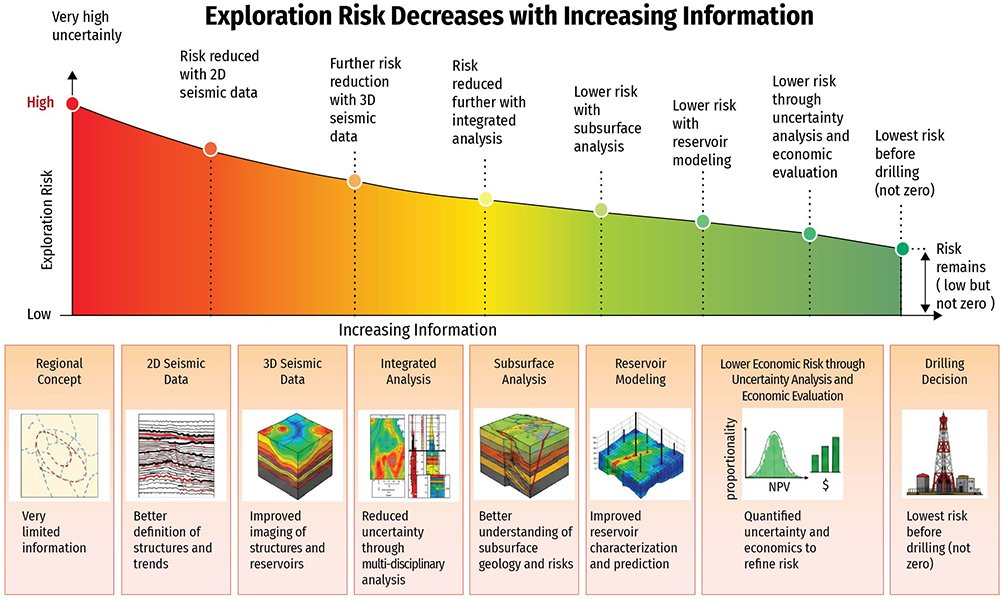
Figure 4. Example of a risk-based exploration framework showing how exploration risk decreases with increasing geological and engineering information before drilling
Quantitative Prospect Ranking
After completing the technical and commercial evaluation of individual exploration prospects, companies commonly apply a quantitative prospect ranking framework to identify the most economically attractive investment opportunities among multiple alternatives. Quantitative prospect ranking is critically important for top management when making exploration drilling decisions. By prioritizing investment in the most prospective drilling opportunities, a company can:
-
Minimize the risk of drilling failure,
-
Maximize financial returns,
-
Achieve faster recovery of invested capital,
-
Generate profits that can be reinvested into future exploration and development activities,
-
Support long-term growth, and
-
Improve the overall success and sustainability of the company
For example, consider five hypothetical exploration prospects named Wells A, B, C, D, and E. Geoscientists estimate the COS for each prospect, while reservoir engineers estimate recoverable reserves. Drilling engineers estimate drilling costs. Based on these technical inputs, a risk-based economic evaluation can be performed using parameters such as Net Present Value (NPV), Expected Monetary Value (EMV), and Cost-Benefit Ratio.
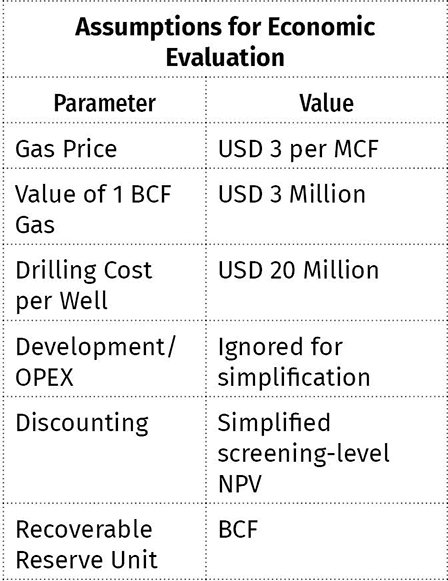
Table 1 shows how companies compare different drilling opportunities using both risk and potential profit.
Table 1. Economic Evaluation of Five Hypothetical Exploration Wells
.jpg)
Table 2. Prospect Ranking Based on Expected Monetary Value (EMV). Expected Monetary Value (EMV) combines possible profit with the probability of success
.jpg)
Well E ranks highest based on Expected Monetary Value (EMV) because it combines a relatively high Chance of Success (40%) with reserve potential (67 BCF). Although Well D contains the largest estimated reserve volume, its relatively low COS significantly reduces its overall risk-adjusted economic value. This analysis demonstrates that both geological probability and reserve size are critical factors in exploration investment decision-making.
The above example demonstrates how quantitative prospect ranking further supports decision-making by integrating all uncertainties into a single evaluation framework and helping identify the best option among multiple opportunities.
Conclusion
It is not possible to eliminate exploration risk. However, a structured risk-based framework can significantly improve drilling success rates and support responsible investment decisions in the petroleum industry. Each exploration prospect should be assessed through integrated seismic interpretation, geological risk assessment, uncertainty analysis, Chance of Success (COS) evaluation, and economic feasibility studies.
Quantitative prospect ranking helps management compare exploration opportunities objectively, optimize investment decisions, and improve long-term exploration success. Ultimately, modern petroleum exploration is not simply about drilling wells, but about making informed scientific and economic decisions in an environment of uncertainty and risk. Therefore, before initiating any drilling program, it must be ensured that every stage of the pre-drill analysis process has been evaluated thoroughly and accurately.
Hoshne Ara Banu, Petroleum Engineer, Adjunct Professor of BUET and MIST
Download Special Article As PDF/userfiles/EP_24_01_SA_Banu.pdf