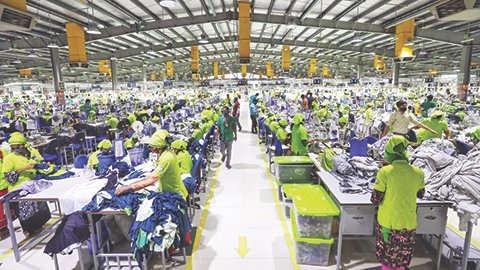
Local garment factories remain far from meeting clean energy consumption targets, held back by high renewable energy costs, limited rooftop space and policy bottlenecks that are slowing adoption across the sector, according to a new study.
The findings come as global buyers tighten sustainability requirements and increase pressure on exporters to cut emissions across supply chains under the EU Corporate Sustainability Due Diligence Directive (CSDDD).
The directive, which came into effect last year, requires garment factories in Bangladesh to generate 35 percent of their power from renewable energy sources by 2035 for smooth Western exports.
On the ground, however, just 3 percent of electricity used by garment factories currently comes from renewable sources, according to the study.
It was prepared by Mapped in Bangladesh (MiB) of the Centre for Entrepreneurship Development (CED) at BRAC University after surveying 878 factories in Gazipur and Narayanganj.
The findings, presented at an event at Sheraton Dhaka yesterday, show that the apparel sector remains heavily dependent on conventional energy despite the 2035 deadline.
It found that 61.5 percent of energy use comes from the national grid and 35.5 percent from captive generation.
A large chunk of respondents, 88 percent, cited high installation costs as a barrier to renewable energy adoption. Another 42 percent pointed to high maintenance costs.
Some 28 percent said a lack of awareness was a factor, while 16 percent blamed unfavorable policies. A further 14 percent cited limited space in smaller factories.