Getting Immediate from Exploration
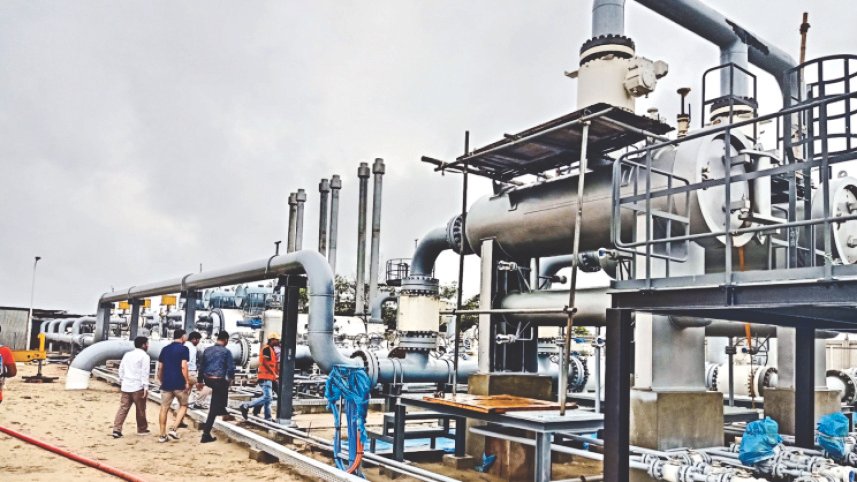
Bangladesh is facing an acute and persistent gas supply crisis, marked by declining domestic natural gas production and increasing dependence on imported LNG. The country has therefore taken the right direction by significantly expanding its drilling programme—from an initial plan of around 100 wells to a broader target of up to 150 wells by 2031, including new drilling and workover activities. The next, and more important, challenge is to prioritize these wells effectively so that Bangladesh can maximize additional gas production in the shortest possible time and maximize the economic benefit. Bangladesh does not simply need drilling—but smarter, better-targeted drilling. During a gas crisis, the priority should be wells that can add reserves quickly, have a high probability of success, and can be brought into production rapidly.
Prioritizing the Right Wells
The number of wells drilled should not be the main measure of exploration success. A large drilling programme may produce only a small increase in gas reserves and production if the wells are not selected carefully. Bangladesh should therefore adopt a two-horizon exploration strategy, addressing the immediate gas shortage while simultaneously preparing for the country’s long-term energy needs.
· Horizon 1—Immediate Gas:This represents the crisis period, during which the immediate objective should be to add gas reserves and production as quickly as possible and bring the supply situation to a more manageable level. This phase may extend for around one year, depending on drilling success and the time required to bring newly developed gas into production.
· Horizon 2—Future Gas:This represents sustained long-term development, focusing on maintaining production, replacing depleted reserves, discovering and developing new resources, and ensuring a stable and sustainable gas supply for the future.
By pursuing both horizons simultaneously, Bangladesh can address the immediate gas shortage without compromising the exploration and reserve replacement needed to secure the country’s future gas supply. During the current crisis, however, the key question should be: Which wells can provide the most additional gas, have the best chance of success, and bring gas into production in the shortest possible time?
In response, we propose a three-category system—A, B, and C—for prioritizing wells. The categories would consider three basic factors: how much gas a well could produce, how likely it is to succeed, and how quickly the gas could reach consumers. This would help Bangladesh move away from simply counting how many wells are drilled and instead focus on how much useful gas is actually added and how quickly it can help reduce the gas shortage.
Category A: Immediate-Priority Wells
As an initial guideline, Category A could include opportunities with substantial recoverable gas potential—around 50 Bcf or more—combined with a high probability of success and a short time to production. The cutoff value is not rigid, but an indicative threshold. A smaller prospect could also receive priority if it can be brought into production very quickly or has strong economic value. Thus, the highest priority Category A wells are to be drilled as soon as possible.
Category A should not be limited to existing fields or development wells; anew exploration well can also be a Category A well if available geological information indicates a high chance of success and significant gas potential.
The main purpose of Category A is toadd reserves quickly and increase gas production as soon as possible. Existing fields and already discovered gas resources are particularly attractive because they usually have less geological uncertainty and may already have pipelines, processing facilities, and other infrastructure. Appraisal wells, near-field wells, and infill wells can also bring gas into production faster than many frontier exploration projects.
The selected Category A wells should then be ranked using Expected Monetary Value (EMV),as thishelps decision-makers compare the possible benefits of a successful well with the financial risk of drilling an unsuccessful one. Before final selection, these should be evaluated using subsurface uncertainty and decision-tree analysisto reduce drilling risks. These tools cannot guarantee drilling success, but can help identify key uncertainties, assess possible outcomes, and select wells with a better balance between gas potential and risk. Category A wells should therefore receive the highest priority for drilling rigs, technical resources, and management attention.
Category B: Selective and Risk-Adjusted Wells
Category B would include wells with moderate uncertainty and potentially significant gas potential, for second-phase consideration.These may include development, in-field, appraisal, or exploration wells where the probability of success is lower than Category A, but the potential gas addition remains attractive. These wells may undergo further technical and economic evaluation before drilling if new data or information are available.
The assessment should consider probability of geological success, expected recoverable gas, reservoir uncertainty, structural and fault-seal uncertainty, infrastructure requirements, expected Monetary Value (EMV), Net Present Value (NPV), and sensitivity analysis. As additional seismic interpretation, seismic reprocessing, geological studies, or other technical work significantly reduce uncertainty, they should be completed before drilling. This helps avoid two extremes: drilling every prospect immediately without sufficient evaluation, or postponing potentially valuable opportunities indefinitely. Development of Category B wells should therefore be the second priority after the most promising Category A opportunities are exhausted.
Figure 1 illustrates how the proposed three-category system can be used to prioritize wells and enhance gas production. The system emphasizes continuous evaluation, reshuffling, and re-prioritization of wells, allowing attractive opportunities to move to a higher priority when new information improves their technical or economic assessment. This approach aims to maximize additional gas production while ensuring that drilling resources are directed toward the most promising opportunities.

Figure 1. Proposed three-category well-prioritization system for enhancing gas production through continuous evaluation, reshuffling, and re-prioritization of drilling opportunities. The categories are dynamic: new information can change the priority of a well.
Category C: Frontier and High-Risk Opportunities
Category C should consist mainly offrontier, high-risk, marginal, or low-confidence prospects. Although they get lower priority during the initial crisis period, selected Category C activities should continue in parallel throughout all phases as part of Horizon 2—Future Gas. Thus, Bangladesh can continue building a pipeline of future exploration opportunities while addressing the immediate gas shortage.
During an acute supply crisis, Category C wells, however, shouldnot consume the majority of the country's limited drilling capacity and financial resources. They should be pursued selectively, if additional geological and geophysical studies significantly improve their success probability. Frontier exploration is essential for Bangladesh's long-term energy security because the country cannot depend indefinitely on its existing gas fields.
Category C wells may have lower immediate drilling priority, but the underlying geological study work should continue effectively. Therefore, frontier exploration activities should not be halted during this crisis time. A strategy focused only on immediate gas production, helping address today’s shortage, could create a more serious supply problem in the future. Seismic surveys, basin analysis, geological and geophysical studies, and frontier exploration planning should continue in parallel, even while drilling resources are prioritized for higher-probability wells. Following detailed technical evaluation, if a frontier prospect is found to have sufficient geological potential, commercial viability, and an acceptable risk level, it can bereclassified and moved to Category A or Category B for accelerated drilling.
The overall strategy thus is simple: produce more gas today while continuously preparing for the gas of tomorrow.
Quantitative Framework for Well Categorization and Prioritization
Completing the technical and commercial evaluation of individual exploration prospects, companies commonly use a quantitative ranking framework to identify the most attractive investment opportunities and prioritize those with the greatest potential for near-term results. Quantitative prospect ranking is critically important for top management when making exploration drilling decisions. By prioritizing investment in the most prospective drilling opportunities, a company can:
- Minimize the risk of drilling failure,
- Prioritise the most attractive wells
- Maximize financial returns,
- Achieve faster recovery of invested capital,
- Generate profits that can be reinvested into future exploration and development activities,
- Support long-term growth, and
- Improve the overall success and sustainability of the company
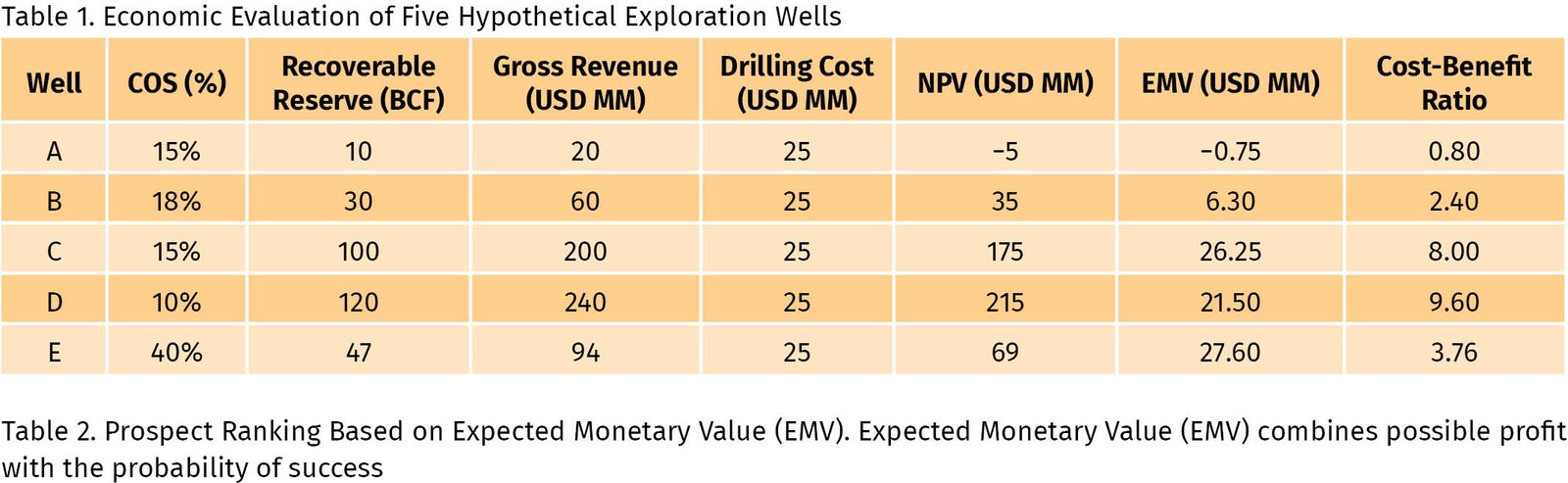
For example, consider five hypothetical exploration or drilling prospects—Wells A, B, C, D, and E—that can be grouped into Category A, Category B, or Category C based on their potential, risk, and economic attractiveness. The COS for each prospect is estimated by geoscientists, while recoverable reserves are estimated by reservoir engineers. Drilling costs are estimated by drilling engineers. Based on these technical inputs, a risk-based economic evaluation can be performed using parameters such as Net Present Value (NPV), Expected Monetary Value (EMV), and Cost-Benefit Ratio.
Assumptions for Economic Evaluation
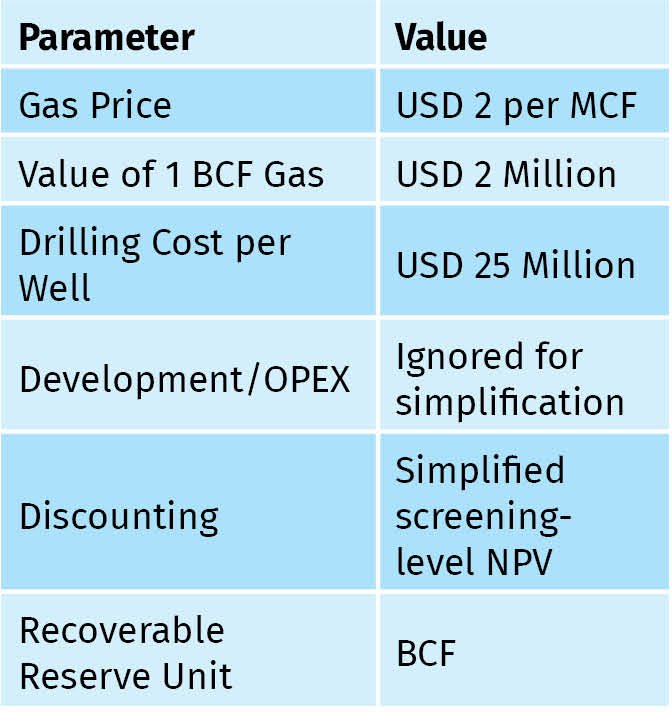
Table 1 shows how companies compare different drilling opportunities based on risk and potential profit, while Table 2 ranks the projects using Expected Monetary Value (EMV), which combines potential profit with the probability of success. However, final drilling decisions may also consider practical factors such as access to gas pipelines and other strategic importance.
Table 1. Economic Evaluation of Five Hypothetical Exploration Wells
|
|
||||||||||
|---|---|---|---|---|---|---|---|---|---|---|
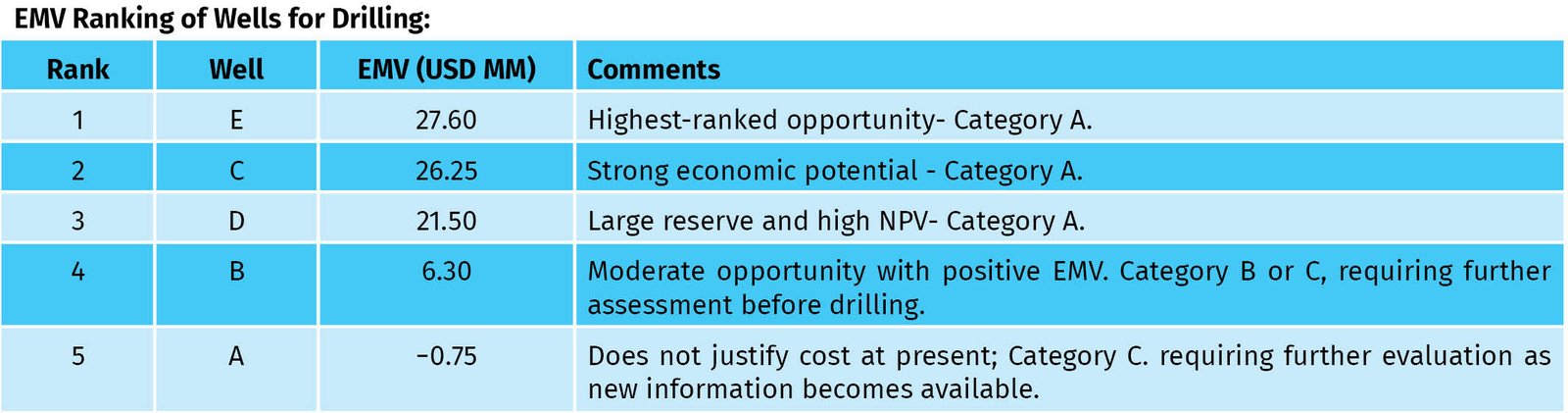
Table 2. Prospect Ranking Based on Expected Monetary Value (EMV). Expected Monetary Value (EMV) combines possible profit with the probability of success
**EMV provides a risk-adjusted basis for prioritizing exploration wells by considering both the potential economic value and the probability of success.
Well E ranks highest based on Expected Monetary Value (EMV) because it combines a relatively high Chance of Success (40%) with reserve potential (47 BCF). Although Well D contains the largest estimated reserve volume, its relatively low COS significantly reduces its overall risk-adjusted economic value. Again, though, C has strong economic potential but ranked below E due to its lower 15% COS.
Well A ranks the lowest- a negative EMV or NPV does not mean a prospect should be permanently rejected. It may simply be uneconomic under current conditions but become attractive later if gas prices rise, costs fall, or uncertainty decreases. Such prospects should be retained and periodically re-evaluated.
The above example demonstrates how quantitative prospect ranking supports decision-making by integrating all uncertainties into a single evaluation framework and helping identify the best option among multiple opportunities.
From Resources to Production: Managing the Petroleum Value Chain
Prioritizing wells addresses the immediate drilling decision, but long-term gas security requires management of the entire petroleum value chain—from identifying resources to converting them into reserves and ultimately production. Continued exploration is essential to identify new gas resources, but resources alone cannot meet demand. They must first be converted into reserves and then developed and brought into production.
This requires a systematic approach that continuously identifies the most promising opportunities, manages geological and commercial uncertainties, and efficiently converts resources into reserves and, ultimately, reliable gas production.
For simplicity, the progression of the entire petroleum value chain can be viewed as Leads to Resources to Reserves to Production, as shown in Figure -2, where:
- Leads / Prospects:Potential gas opportunities that need to be studied and evaluated.
- Resource:gas that is believed to exist in the subsurface and may be technically recoverable.
- Reserve:gas that is proved to be recoverable under current technical, economic, and operating conditions.
- Production:gas that is actually produced and delivered to consumers
.
Figure 2. The petroleum value chain from resource identification to reserve conversion and gas production, supported by RGR, R2R and RRR as complementary management indicators.
The objective, therefore, is not simply to increase the resource base, but to create a continuous and efficient pathway from resources to reserves and ultimately to production.
To support this objective, petroleum companies and policymakers need a simple way to monitor where the main bottlenecks occur. Three complementary indicators can provide such a management framework:
- Resource Growth Rate (RGR):indicates whether the recoverable resource base is growing.
- Resource-to-Reserve Ratio (R2R):indicates how effectively identified recoverable resources are being converted into reserves.
- Reserve Replacement Ratio (RRR):indicates whether newly added reserves are sufficient to replace the gas being produced.
Together, these indicators provide a broader picture of the health of the petroleum value chain. RGR focuses on the future resource base, R2R on the conversion of resources into reserves, and RRR on maintaining reserves as production continues. They can therefore help management identify where attention and investment are most needed.
These indicators should not, however, be treated as stand-alone measures of exploration or business performance. A high RGR, for example, may reflect substantial new resources without demonstrating that they can be economically developed. Similarly, a strong RRR does not necessarily mean that production is increasing. The indicators are most useful when combined with geological, technical, commercial, and operational information to support investment decisions.
For a national oil and gas company, RRR could be considered alongside production performance as a simple and useful management indicator. With clear definitions, transparent reporting, and proper verification, these indicators could also be linked to management performance and incentive systems.
If incentives are based only on adding reserves, the company may focus on increasing reserves without ensuring that those reserves are actually developed and brought into production. Including production performance as an incentive can encourage the entire company to work together to improve production and remove bottlenecks within the petroleum value chain.
This balanced approach would encourage both higher production today and adequate reserve replacement for the future. This integrated approach helps decision-makers compare opportunities consistently and direct limited financial and technical resources toward projects where most needed.
Managing the Petroleum Value Chain- Reserve and Reservoir Management System
In this framework, Resource Growth Rate (RGR), Resource-to-Reserve Ratio (R2R), and Reserve Replacement Ratio (RRR) should be monitored together as the three initial key management indicators. Many major oil and gas companies regularly calculate R2R and RRR and report these indicators in their internal annual reports.
For sustainable production, the aim should be to maintain an RRR of 100% or higher over time. A sustained RRR below 100% means that reserves are being produced faster than they are being replaced, gradually reducing the reserve inventory. RRR therefore provides an important indication of whether today’s production is being adequately replaced by new reserves to support tomorrow’s production.
At present, maintaining an RRR above 100% can be challenging, even for large international and national oil and gas companies. Reserve replacement can vary significantly from year to year because of exploration results, production levels, reserve revisions, and the timing of major projects. For example, reported reserve-replacement performance among selected major companies illustrates this variability:
· bp: According to bp’s 2025 reporting, the company recorded an organic proved reserve replacement ratio of 90% (S&P Global).
· Chevron: According to Chevron Corporation’s 2025 Fourth-Quarter Results (January 30, 2026), Chevron reported a reserve replacement ratio (RRR) of 158% in 2025. This indicates that the company added proved reserves equivalent to 158% of the reserves it produced during the year.
· PETRONAS:According to the PETRONAS Integrated Report 2023, PETRONAS reported a three-year average 1P Reserve Replacement Ratio (RRR) of 1.6 (160%) as of 1 January 2024. This indicates that, on a three-year average basis, PETRONAS replaced more than 100% of its 1P reserves produced during the period.
These examples demonstrate that RRR is an important indicator of a company's ability to replace the reserves it produces, but it can vary considerably from year to year. It should therefore be viewed primarily as a long-term management indicator rather than a one-year performance score. RRR should also be considered alongside other indicators, such as Reserve Growth Rate (RGR) and Resources-to-Reserves (R2R) conversion, to provide a more complete picture of the health and sustainability of the petroleum resource base.
For Petrobangla, RRR values do not appear to be reported in publicly available documents. Regular monitoring of RRR, RGR, and R2R could help identify where bottlenecks exist across the petroleum value chain. This would help management determine whether the main challenge is finding new resources, converting resources into reserves, or bringing reserves into production. Once the bottleneck is identified, financial, technical, and human resources can be directed to the area where they are likely to have the greatest impact.
Conclusion
Bangladesh’s gas crisis is urgent, and accelerating drilling is a timely step. However, drilling more wells alone is not a cost-effective solution; the focus must be on selecting the right wells and bringing gas to production quickly, based on a two-horizon strategy.
Horizon 1 (Immediate Gas)should prioritize Category A and selected Category B wells with high potential for rapid conversion into production. Simultaneously, future Gas should continue in parallel through Category C prospects, seismic programmes, basin studies, reprocessing and reinterpretation of existing data, and frontier exploration. Horizon 2 should not be a separate or isolated programme. When new studies identify a high-confidence and commercially attractive prospect, it should be reassessed and, where justified, recategorized for accelerated drilling.
This approach ensures both immediate gas supply and long-term resource development. If implemented effectively, the drilling programme will become a tool for converting petroleum potential into production and reducing dependence on imported LNG.
Hoshne Ara Banu, Petroleum Engineer and adjunct professor at MIST and BUET
Download Special Article As PDF/userfiles/EP_24_08_Special_Article.pdf