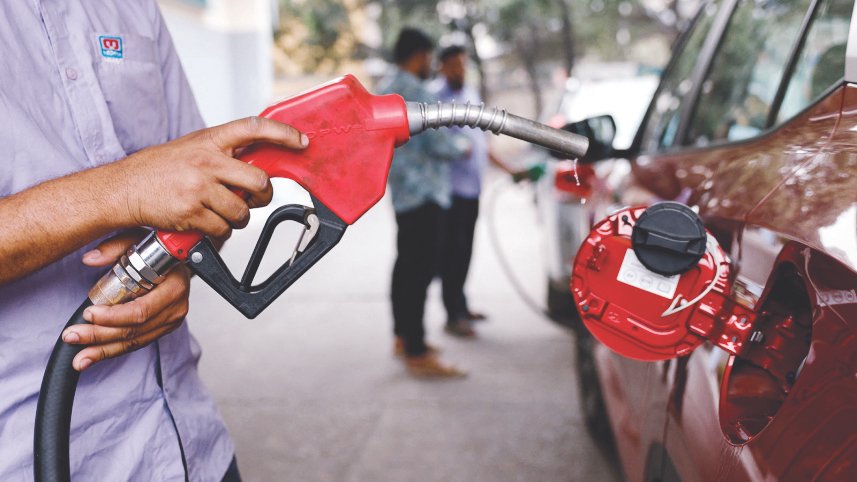
Bangladesh's decision to raise the prices of diesel, octane, petrol and kerosene by Tk 20 per liter from September 21, 2026, has triggered fresh concerns over inflation, household purchasing power and the cost of doing business. The government has justified the increase by citing surging international fuel prices, supply-chain disruptions and mounting losses at Bangladesh Petroleum Corporation (BPC). However, the steep adjustment comes at a particularly difficult time, with the country already grappling with severe gas and electricity shortages, persistent inflation and rising transportation costs.
While higher import costs have placed considerable pressure on BPC's finances and foreign exchange reserves, questions remain about whether a single, across-the-board increase was necessary or whether alternative measures could have reduced the burden on consumers. The decision has also revived calls for greater transparency, improved efficiency at BPC and an independent, public process for determining fuel prices.
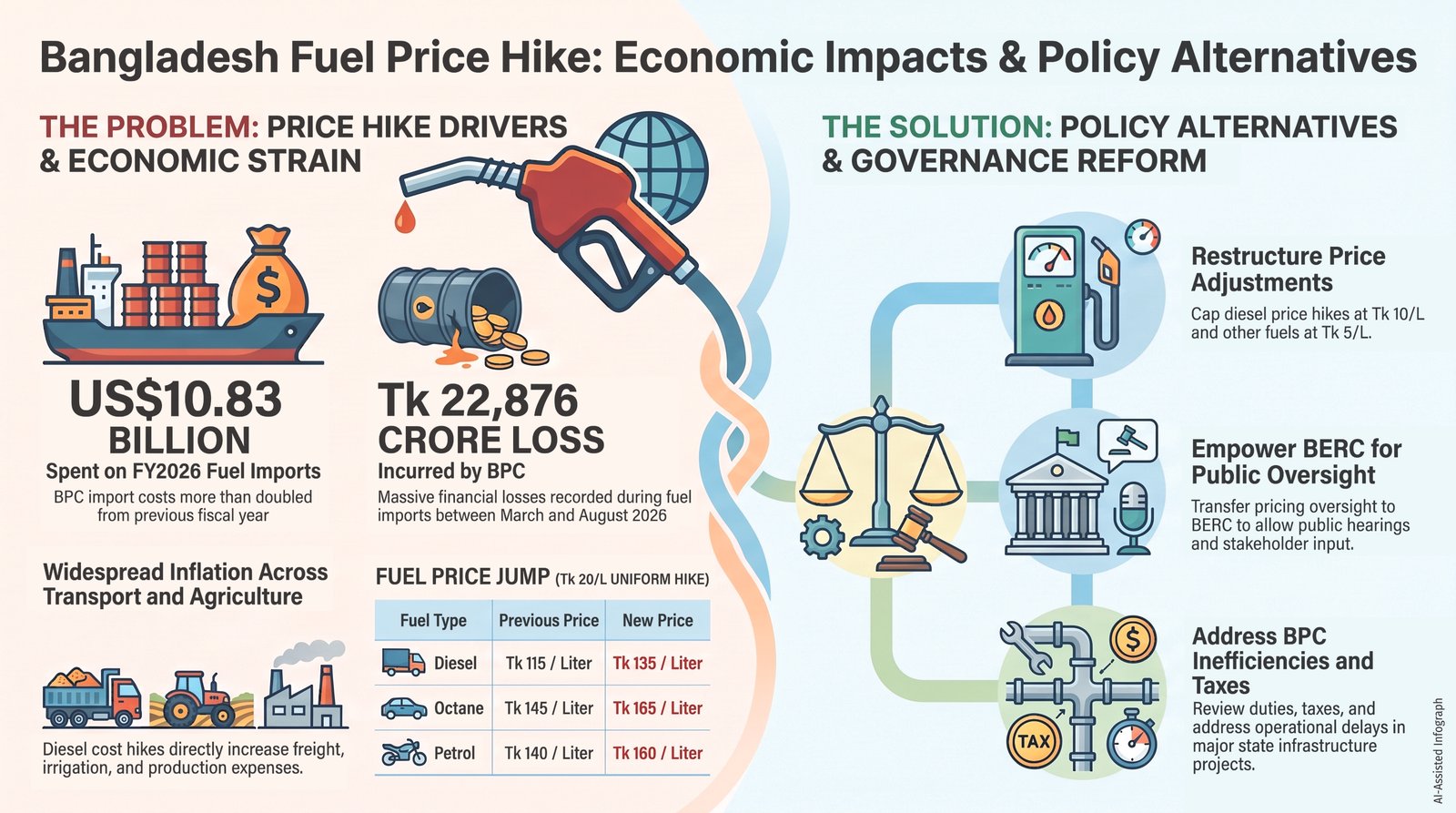
The Energy and Mineral Resources Division (EMRD) of the Ministry of Power, Energy and Mineral Resources (MPEMR) announced adjustments to the prices of diesel, octane, petrol and kerosene, effective September 21, 2026. Diesel prices increased from Tk 115 to Tk 135 per liter, octane from Tk 145 to Tk 165, petrol from Tk 140 to Tk 160, and kerosene from Tk 135 to Tk 155. The adjustment raised the price of each fuel by Tk 20 per liter.
In its explanation, the government said rising international fuel prices, driven by wars and conflicts, and supply-chain disruptions had created unavoidable circumstances. According to the government, the increase was necessary to mitigate the substantial losses incurred by Bangladesh Petroleum Corporation (BPC).
However, the increase has come at a time when Bangladesh is struggling with an unprecedented electricity and gas crisis, creating further adverse economic effects. It has added to the inflationary pressure already weighing heavily on the population. Transport fares have increased across different modes, while prices of essential commodities have also risen. People have genuine reasons to feel anxious and frustrated.
Questions are being raised about whether the adjustment could have been introduced in smaller increments or delayed until the prevailing gas and electricity crisis eased. The diesel price increase, in particular, will inevitably raise costs across road and rail transportation, including buses, trucks and other vehicles. Higher transportation costs, in turn, will put further upward pressure on the prices of essential commodities.
The announcement of a new national pay scale for government employees has also raised concerns about additional inflationary pressure. Experts believe the government should have consulted relevant stakeholders before making such a substantial increase in fuel prices.
For reasons best known to the government, the authority to determine liquid-fuel prices has not been assigned to the Bangladesh Energy Regulatory Commission (BERC). As a result, stakeholders have no opportunity to express their views through public hearings. Ultimately, end users bear the cost.
According to BPC, it incurred losses of approximately Tk 22,876 crore on fuel imports between March and August 2026. International fuel prices increased significantly during this period. The public is asking whether the government had alternatives to a price increase in managing the situation. Legitimate questions include whether better management, cost controls, and tax adjustments could have limited the increase to a much lower level.
BPC and EMRD have their own arguments. Some government ministers have cited the need to prevent the trafficking of liquid fuel across the porous border, arguing that keeping domestic prices below those in neighboring countries could encourage smuggling. However, this concern could be addressed through stronger policing and surveillance along the border.
There are also legitimate economic reasons for adjusting fuel prices. Bangladesh relies almost entirely on imported petroleum products. The mini-refinery operated by Sylhet Gas Fields Limited (SGFL) at Rashidpur processes condensate produced from gas fields in the Greater Sylhet region to manufacture petrol, octane and kerosene.
Recently, condensate production has declined alongside natural gas output. In the near future, however, production may recover as some condensate-rich gas wells are brought into production. The government could also consider importing condensate to operate the Rashidpur refinery at full capacity.
The Bangladesh Standards and Testing Institution (BSTI) could review the quality of domestically produced petroleum products. Bangladesh is believed to be self-sufficient in petrol and octane. There was a time when the country was even able to export petrol.
BPC sources said the corporation spent approximately US$10.83 billion on fuel imports in FY2025–26, more than twice the amount spent in the previous fiscal year. One reason, apart from higher import costs, was the increased use of diesel to cope with power load shedding. Industries consumed more diesel for captive power generation, while households relied more heavily on diesel-powered generators.
The rise in international petroleum prices increased import costs and put additional pressure on foreign exchange reserves. BPC's financial position consequently became increasingly constrained. In September 2026, its working capital reportedly stood at Tk 12,638 crore.
BPC maintains a buffer stock equivalent to 60 days of fuel consumption as a contingency measure to address supply disruptions. However, the financial pressures outlined above do not necessarily justify raising the prices of all four petroleum products by Tk 20 per liter at once.
The case for adjusting diesel prices differs from that for petrol, octane and kerosene because diesel has a much wider role in the economy. It is extensively used in irrigation, freight transportation, industry, and road transport.
An increase in diesel prices therefore has far-reaching implications across the supply chain. It raises irrigation costs for farmers, transportation costs for trucks and vessels, and production costs for industries. Through this domino effect, the prices of essential food items and other consumer goods are likely to rise further.
Bangladesh is passing through a critical period in its economic history. The new government is struggling to manage the electricity and gas supply crisis, while inflation is placing immense pressure on households with limited incomes. Many people are already living from hand to mouth. This is hardly an ideal time for a sharp increase in petroleum prices.
The government should have carefully analyzed the likely economic and social consequences of the price increase before implementing it. Alternative measures to manage the situation should also have been thoroughly reviewed.
Duties and taxes, transportation and storage, refining, and other operating expenses all contribute to the cost of supplying fuel. Informed observers have also raised concerns about losses arising from inefficiencies and corruption at BPC.
Why did BPC take two years to finalize the operator for its Single Point Mooring (SPM) project? Why was the liquid-fuel pipeline from Chattogram to Dhaka constructed in a manner that has raised questions about the competence of the contractors involved? Why has the capacity expansion of Eastern Refinery Limited (ERL) been delayed for so long?
These are legitimate questions that require clear answers. Delays and inefficiencies in major infrastructure projects can increase costs, undermine operational efficiency, and weaken the financial position of state-owned enterprises. Such shortcomings must be examined rather than allowing consumers to bear the entire burden through higher fuel prices.
In view of the circumstances outlined above, we suggest reviewing the latest price increases and reducing the increases for octane, petrol and kerosene to a nominal Tk 5 per liter and for diesel to Tk 10 per liter. The government should also review duties and taxes, while BPC must improve operational efficiency and reduce avoidable losses.
The general public should not be made to bear the full brunt of corruption and inefficiency in a state-owned enterprise. While the financial sustainability of BPC is important, fuel-pricing decisions must also account for their wider effects on inflation, production costs, transportation and household welfare.
Finally, we suggest empowering BERC to determine the prices of all fuels and petroleum products through a transparent public-hearing process that allows all stakeholders to express their views. The respective roles of BPC as a commercial enterprise and the government as a policymaker should also be reviewed to ensure greater accountability and transparency.
A sustainable fuel-pricing framework must balance international market realities and the financial requirements of the supplier with the economic capacity of consumers. Without greater transparency, stronger institutional oversight, and improvements in BPC's efficiency, repeated price increases risk transferring the cost of systemic shortcomings to the public.
Download Analysis As PDF/userfiles/EP_24_08_Analysis.pdf