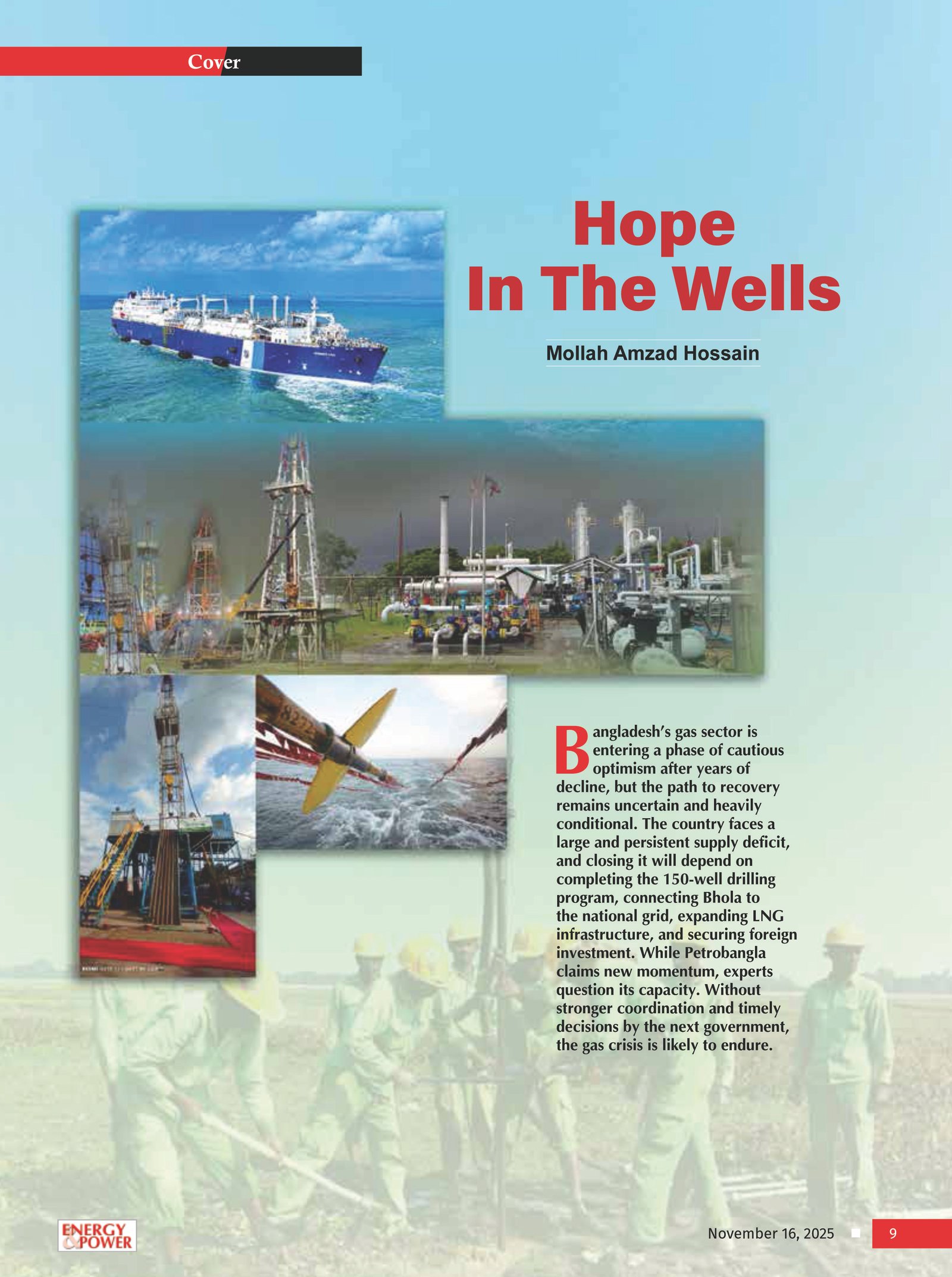
Bangladesh’s gas sector is slowly inching out of a long period of uncertainty, giving policymakers and energy experts their first real reasons for cautious optimism. After years of declining production and recurring shortages, some believe the country could start to see an improvement in supply by the early 2030s. Still, it remains far too soon to say how much of today’s shortfall can realistically be closed.
Right now, Bangladesh needs about 4,200 MMCFD of gas each day, but falls short by roughly 1,500 MMCFD. If the government can enforce efficiency, curb waste, and keep total demand near 4,500 MMCFD by 2030, experts say the deficit may at least stop widening — and could even begin to shrink. But that outlook rests on several critical conditions. The Energy Division and Petrobangla stress that Bangladesh must complete the remaining 130 wells under the 150-well drilling program and connect the promising Bhola gas fields to the national grid.
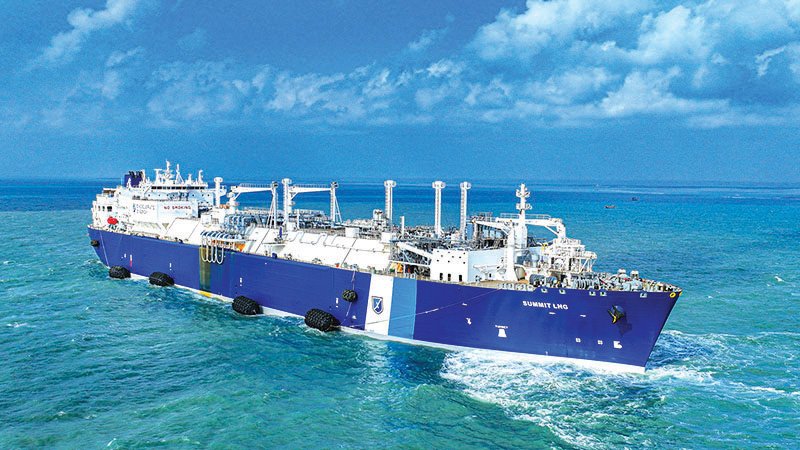
One senior Petrobangla official, requesting anonymity, noted that the situation might already be improving had the government not cancelled LNG projects approved under a special act or stalled the rig agreements needed for drilling. Looking ahead, he said meeting the 2030 goal will require staying on course with the 150-well plan, adding at least one additional FSRU, and accelerating the land-based LNG terminal so it can begin operating by 2031.
Experts Remain Skeptical about Petrobangla’s Capacity
Energy experts are not convinced about the success of Petrobangla’s drilling plan. They argue that neither Petrobangla nor its subsidiary companies possess the management or technical capacity to complete the plan by 2030. Petrobangla, however, disagrees, saying experts are basing their skepticism on past performance. The organization claims that over the past two years, both the Energy Division and Petrobangla have adopted a new results-driven approach to gas exploration and development.
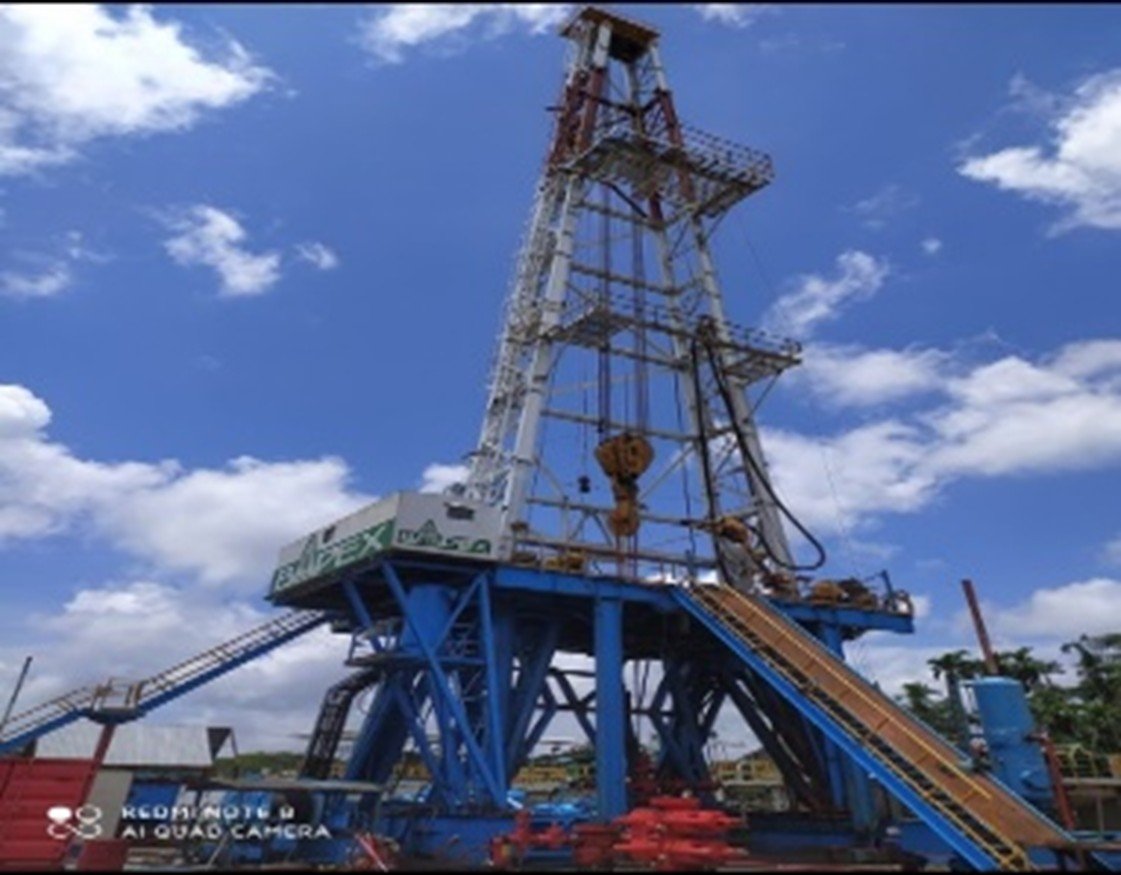
For the first time, nine rigs are operational in Bangladesh, and the number will increase to 11 starting in January next year. With this capacity, Petrobangla believes drilling at least 30 wells per year should not pose a major challenge. However, the continuation of this momentum will depend on the policy direction of the incoming government.
Over the past 125 years, Bangladesh has drilled 100 exploration wells – the most recent being the 100th well in Jamalpur. In total, 258 wells have been drilled onshore and offshore. Since 2009, several onshore exploration plans have been undertaken, but none have achieved significant success. This has shaken confidence in Petrobangla and BAPEX’s ability to execute their drilling plans.
Former BAPEX Director Murtaza Ahmed Faruque said, “I do not believe that Petrobangla and BAPEX will be able to complete the 150-well program by 2028. I will be satisfied if even half of the plan is implemented.”
Why is there Still Hope around the 150-Well Plan?
As domestic production declined rapidly, the government approved a plan in 2022 to drill 46 wells, including 16 exploration wells, with the hope of restoring production to 2,000 MMCFD. The plan is expected to add 618 MMCFD of new domestic supply within three years. Later, the plan was revised to 50 wells, with a new target of adding 648 MMCFD. So far, 19 wells under the 50-well plan and one well from the 100-well plan (20 in total) have been drilled.
According to Petrobangla, these wells have collectively added 210 MMCFD of production capacity, though only 90 MMCFD has been connected to the national grid due to pipeline gaps. Work on another seven wells under the 50-well plan is ongoing and expected to be completed by January next year. Of the remaining 23 wells, seven will be drilled by BAPEX and 16 by contractors. Of these, 18 wells are at the DPP stage, 17 are approved, and one is awaiting approval. Petrobangla expects to complete the entire 50-well program by June 2026, adding another 438 MMCFD. But due to infrastructure gaps, only about half of that may be added to the national grid.
A Petrobangla official, requesting anonymity, said: “The biggest success so far is that we have slowed down the decline in production from national companies. Once the full 50-well program is completed, output from national companies should stabilize, and may even increase slightly.”
However, production from IOC-operated fields continues to decline by 140–150 MMCFD per year, a trend expected to continue.
The 100-Well Program: Ambition vs Reality
Petrobangla has already initiated work on the 100-well program. A total of 21 DPPs have been finalized: 20 approved and one pending. The plan includes 52 exploration wells, 17 development & appraisal wells, and the rest workovers. Field implementation will begin in July next year. Petrobangla acknowledges that it will not be possible to finish all 100 wells by 2028. But with sustained effort and increased rig capacity, it believes the full program can be completed by 2030.
Former Petrobangla Director Engr. Ali Iqbal Md. Nurullah offered a practical proposal: “Achieving the target is essential, but the strategy must change. Contractors must be given clusters of 6–10 wells with strict deadlines and strong monitoring. This would significantly increase the chances of meeting the targets.”
However, the Energy Division claims that an external monitoring committee has been formed to ensure that contractors and BAPEX can complete their work on time. In addition, a daily monitoring committee of Petrobangla and company representatives is also active. Because of this, there is no scope for falling behind the target.
Petrobangla sources say that if the 150-well drilling plan, including four deep-drilling wells, is completed, total production capacity will increase by 1,133 MMCFD (648 + 985). As a result, during this period, national gas field production can be raised again to 2,000 MMCFD. However, during the same period, IOC-operated fields will see a significant decline in output. But the essential condition is that work to connect Bhola to the national grid must begin immediately, without losing even a single day.
Bhola’s Gas and the Challenges in Reducing Shortage
Bhola currently has nine gas wells, five of which are in production. Although the capacity is 100 MMCFD, due to low local demand, production is restricted to 60–80 MMCFD. Work is ongoing to bring the remaining four wells online. Under the new plan, 10 additional wells will be drilled in Bhola. Once all 19 wells are operational, Bhola’s production capacity could reach 320–520 MMCFD.
Therefore, pipeline construction to connect Bhola to the national grid must begin immediately. Even though the issue has been discussed for nearly 25 years, no implementation steps have been taken. The interim government likely lacks enough time to decide on building the pipeline. Therefore, whichever elected government comes to power must take up and implement the pipeline project without delay.
Gas Import & Infrastructure Expansion
Bangladesh currently has an LNG import capacity of 1,100 MMCFD, and with available pipeline facilities, 1,050 MMCFD can be imported. The two FSRUs can receive and regasify 114 LNG cargoes per year. The interim government has fully utilized the FSRU capacity this year to reduce industrial gas shortages.
Under the previous Awami League government, agreements were made to expand LNG import infrastructure:
• A third FSRU contract was signed with Summit Group
• A fourth FSRU in Kuakata was initiated with U.S.-based Excelerate Energy
• Negotiations were underway with two entities to import RLNG from India via pipeline
These were all executed under the Speedy Supply of Power and Energy Act. However, the interim government halted the ongoing negotiations and canceled the third FSRU contract with Summit –now pending in court.
Officials at the Energy Division and Petrobangla, speaking on condition of anonymity, said that there is no alternative to gradually increasing LNG imports to address the gas shortage. Yet the interim government has taken no effective steps to expand infrastructure after canceling previous agreements.
Thus, once a new government takes office, it must urgently resume negotiations for LNG infrastructure expansion and review canceled agreements for faster results.
A new FSRU would take at least 3 years to install. A land-based terminal would take 5–6 years. Additionally, new transmission pipelines must be constructed simultaneously. Otherwise, increased LNG imports will not help reduce shortages.
Foreign Investment in Oil & Gas Exploration
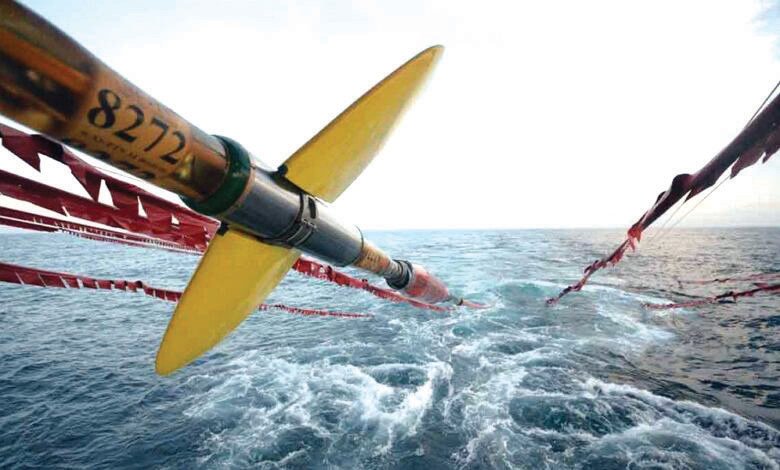
Petrobangla has finalized draft offshore and onshore PSCs to attract foreign investment for oil and gas exploration. Preparations for bidding have also been completed. However, according to one Energy Division source, the interim government is unlikely to approve the final PSCs. Therefore, the elected government must quickly approve the draft PSCs after taking office. Petrobangla believes that tenders can be invited within 3–4 months thereafter.
Onshore, the Chittagong Hill Tracts are considered highly promising. If PSCs are signed with IOCs, success may come within 3 to 5 years. Offshore exploration, however, may require 8–10 years to yield results. Because energy companies are hesitant during the interim government period, PSCs are not being finalized. A newly elected government is expected to restore investor confidence.
Chhatak Gas Field & Legal Issues
A long-pending case between Petrobangla and Niko involving a section of the Chhatak gas field is yet to receive a verdict. Although the hearing is complete, the financial liability determination order has not been issued. As a result, Petrobangla cannot undertake any new exploration work in Chhatak, which is widely regarded as a promising structure. Once the court verdict is delivered, exploration can begin, potentially leading to major discoveries. Because the field is close to the national grid, new production can be connected quickly, playing a crucial role in reducing the ongoing gas crisis.
Conclusion
For the first time in the country’s history, nine drilling rigs are running at once, a rare moment of momentum in Bangladesh’s long-stalled gas sector. Within the next few months, that number is expected to rise to 11. Petrobangla argues that with this capacity, it should be possible to finish the remaining wells under the 150-well program, including four deep wells, within the planned timeline. At full pace, the rigs can drill around 30 wells a year.
But drilling alone won’t solve the crisis. The bigger hurdle lies in connecting new production to the national grid. Several wells, especially those in Bhola, remain stranded without transmission links. Unless pipeline construction begins early next year and the Bhola fields are integrated without delay, much of the new gas will remain unusable. The third FSRU also needs to be operational by 2029 for the supply outlook to meaningfully improve.
If all these pieces fall into place, Bangladesh could raise its total gas supply to around 3,500 MMCFD by 2030, with domestic output potentially climbing back above 2,000 MMCFD. But that outcome depends on something the sector has struggled with for years: coordination. Previous attempts to ease shortages have repeatedly faltered because exploration, production, grid expansion, and LNG infrastructure were pursued in isolation.
This time must be different. The incoming government will need to move quickly, pushing forward ongoing projects and launching new ones, to prevent the gas crisis from dragging on for yet another decade.
Download Cover As PDF/userfiles/EP_23_11_Cover.pdf