Bangladesh urgently needs coal to support its newly built large-scale coal-fired power generation capacity, representing an estimated investment of US$20–30 billion. The country’s installed (and soon-to-be commissioned) coal-based generation capacity now exceeds 8,000 megawatts (MW), requiring about 20 million tonnes (Mt) of Phulbari- or Barapukuria-quality coal annually—or a larger volume of imported, lower-quality coal.
Currently, Bangladesh’s coal supply is almost entirely import-dependent, as the country’s only operating coal mine, Barapukuria, can supply only its own mine-mouth power plants (525 MW). Imported coal generally has a lower calorific value—between 4,500 and 5,000 kcal/kg (GAR)—compared to the country’s high-quality domestic coal, which exceeds 6,600 kcal/kg (GAR). This means that generating the same amount of power from imported coal requires roughly 30% more coal than using locally sourced coal.
The financial and logistical challenges of coal imports are substantial. Bangladesh spends US$4–5 billion annually on imported coal for the power sector alone—funds that could otherwise be conserved through the development of domestic coal resources.
In this context, the Phulbari coal deposit could make a transformative contribution to Bangladesh’s energy security. Its substantial open-pit mining reserves, large annual production capacity, consistent high quality, and reliability of supply throughout the operational life of large power plants make Phulbari a highly attractive and viable primary energy source for the country.
Phulbari has the Largest Mineable Reserve
The proposed Phulbari mine contains Bangladesh’s largest open-pit mining reserve, estimated at 475 million tonnes (Mt). This estimate is conservative, and additional reserves could be identified as mining progresses and geological understanding improves.
The current mine plan envisions more than 83% recovery of the total estimated resource of 572 Mt (JORC-compliant)—a stark contrast to the meager 4–6% recovery achieved so far at the Barapukuria underground mine. Similarly, the proposed Dighipara mine targets production of 90 Mt from a total estimated resource of 706 Mt, translating to only 12–13% recovery. In both cases, a significant portion of the country’s valuable coal resources remains untapped and ultimately abandoned.
Phulbari Mine Ensures Large Annual Production
The Phulbari coal basin is ideally suited for efficient open-pit mining. The proposed mine plan calls for an annual output of 15 Mt over a 30+ year mine life—enough to meet nearly 60% of Bangladesh’s current annual thermal coal demand. This underscores Phulbari’s strategic importance in achieving the country’s energy security objectives.
The mine can support the full operational life (25–30 years) of large power plants, providing a critical incentive for investors in the power sector. First coal production from Phulbari could begin within 2–3 years of construction, compared to the 8–10 years typically required for underground mines. For reference, Barapukuria took over 12 years to reach commercial production, while Dighipara is projected to take 8–10 years to complete construction.
Open-pit mining not only delivers large annual output but also ensures lower and more competitive production costs. Phulbari coal could meet Bangladesh’s domestic demand sustainably, at a competitive price, and with a reliable supply.
Phulbari Offers Energy Security and Diversity
Developing the Phulbari coal deposit would provide Bangladesh with an alternative, reliable, and affordable source of primary energy for power generation—enough to fuel more than 6,600 MW—as well as for industrial and domestic uses. The mine could significantly reduce the country’s growing dependence on costly coal imports by meeting nearly 60% of Bangladesh’s projected thermal coal demand. It would also eliminate the challenges and expenses associated with long-distance coal freight and complex handling logistics.
Coal production from Phulbari would save the country a substantial amount of foreign exchange. Importing an equivalent volume of Phulbari- or Barapukuria-quality coal to support 6,600 MW of generation capacity would cost approximately US$2.6 billion per year. Domestic production would not only prevent such foreign exchange outflows but also generate billions of dollars in taxes and royalties for the government. In addition, the project would create well-paid jobs, strengthen both the local and national economies, and foster skills development in Bangladesh. These benefits currently flow to foreign coal-exporting countries such as Indonesia and Australia.
Phulbari Coal Quality Is Consistent and Assured
The Phulbari coal deposit consists of thick seams of high-volatile bituminous coal, with an average composite thickness of 38 meters, reaching over 60 meters in parts of the basin. Extensive testing confirms the consistency of coal quality across the deposit, allowing for efficient mining and production of high-grade coal products.
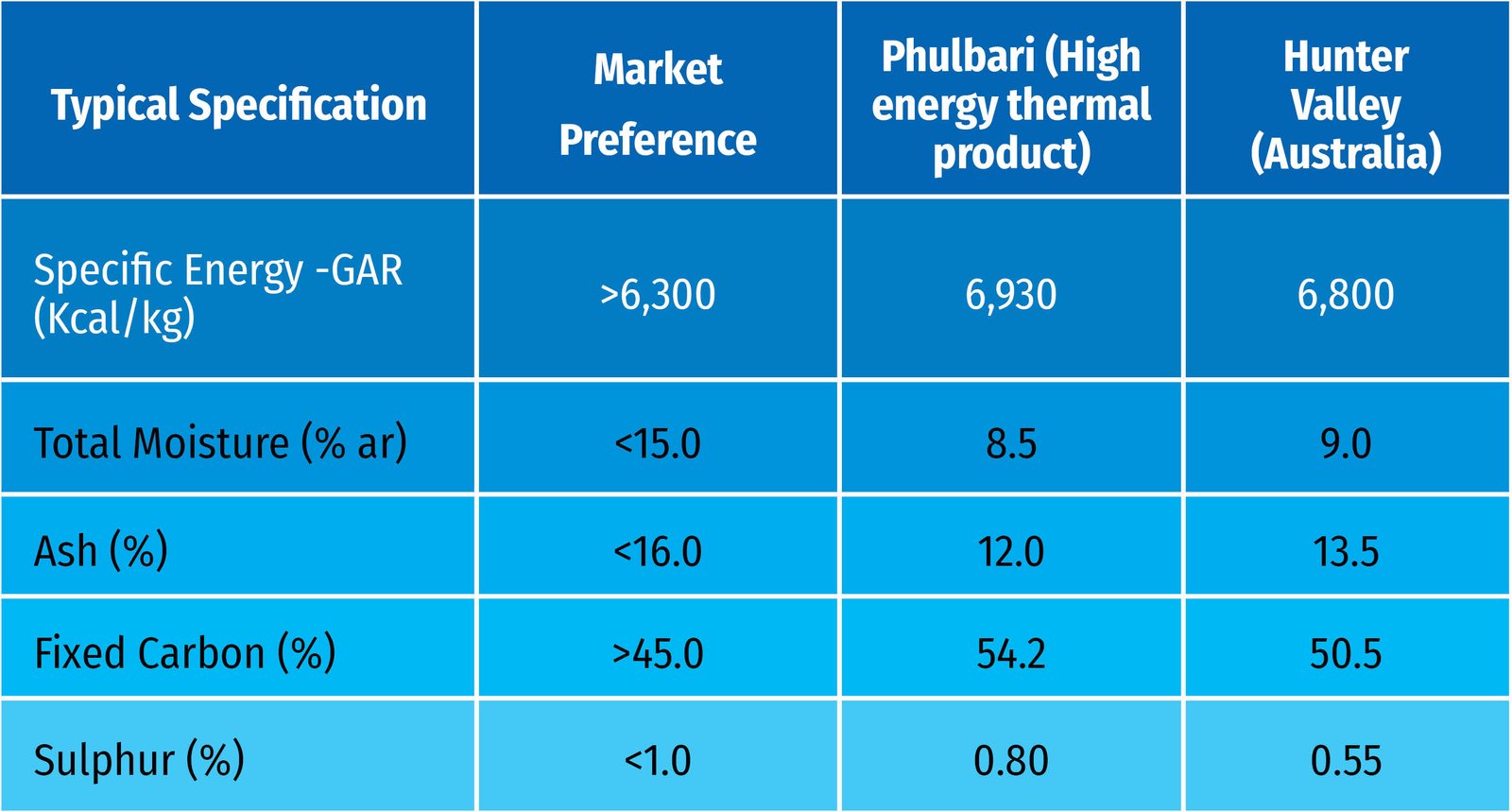
The mine will ensure long-term coal quality assurance and secure supply—both essential for establishing and sustaining large-scale coal-fired power plants. The high-quality Phulbari coal is comparable to internationally traded premium-grade thermal coal, making it a highly desirable product for prospective domestic and regional customers.
Phulbari Ensures a Reliable Domestic Coal Supply
Coal imports inherently carry risks of supply disruption and price volatility caused by both natural and human factors. In contrast, domestic coal production is far less vulnerable to such external shocks and is largely insulated from international energy market fluctuations. Coal from the Phulbari mine can be transported to all domestic demand centers within 2–3 days, while coal imports from the nearest export source—Indonesia—typically require at least two weeks for shipping and lighterage operations.
Bangladesh’s port and coal-handling infrastructure also remain inadequate, even as several large coal-fired power plants have already begun operation. Ensuring smooth import logistics would require major investments, including extensive capital and maintenance dredging of access channels to coal ports and the construction of modern handling facilities.
Phulbari Operation Enables Recovery of Valuable Industrial Co-Products
The overburden materials above Bangladesh’s coal deposits contain valuable industrial minerals such as silica sand, kaolin clay, and construction sand or aggregates. These can only be accessed through open-pit mining and have strong domestic market demand.
The Phulbari open-pit mine plan aims to recover these co-products during the coal extraction process, with an estimated mineable quantity of around 900 Mt. Importantly, these co-products would become available from the start of mining, well before the coal seams are reached, generating early cash flow to support initial mine development costs.
This early-stage production of industrial minerals could attract new co-product-based industries in and around the mining area, once the availability and reliability of raw material supply are established. The local economy would benefit from job creation, infrastructure development, and supporting services linked to the mine’s operations.
Phulbari Has Potential for Additional Coal Resources
Geophysical and drilling data indicate that the Phulbari coal deposit extends southward, suggesting potential for additional coal beyond the currently identified 572 Mt resource inventory. Discovering more reserves would increase the total mineable quantity and extend the mine’s operational life.
Moreover, coal deposits in the southern part of the Barapukuria basin—estimated at 54 Mt—and adjacent areas could be accessed via the Phulbari Box Cut, which would otherwise be uneconomical to develop independently. A combined development approach offers several advantages:
-
Eliminates the need for separate, costly box cuts
-
Provides immediate access to the Barapukuria coal basin
-
Enables optimized backfilling and land rehabilitation of the merged open pits after coal extraction
Phulbari Is Ready for Development
Phulbari remains the only coal mining project in Bangladesh that has undergone a comprehensive Environmental and Social Impact Assessment (ESIA) and a Detailed Feasibility Study, both prepared to international standards and extensively reviewed by global experts. The mine development plan aims to begin delivering coal within 2–3 years of construction commencement to meet Bangladesh’s immediate energy needs.
London-based GCM Resources plc, the project proponent (operating through its local subsidiary), is well positioned to finance mine development with support from its strategic partners.
Historically, coal use in Bangladesh was limited mainly to brick kilns, but demand has surged to over 20 Mt per year as large coal-fired power plants come online. In the absence of a reliable and consistent domestic supply, Bangladesh has been forced to rely on costly imports—draining valuable foreign exchange reserves.
Bangladesh cannot afford to depend solely on imported coal to fuel its growing fleet of large coal-fired power plants while its own high-quality coal resources remain untapped. The current and projected demand scenario underscores the urgent need to develop and utilize these domestic resources efficiently.
Among the country’s five known coal deposits, Phulbari stands out as the most strategically important for meeting national energy needs. The mine offers a viable alternative to imported fuels, with the potential to save billions of dollars in foreign exchange and enable thermal coal contracts to be settled in local currency.
Bangladesh requires a large, stable supply of coal to support its installed generation capacity—and Phulbari is ready to deliver, providing high-energy, competitively priced domestic coal for decades to come.
Md. Badruzzaman, Manager Geology, GCM Resources plc (subsidiary operations)
Download this Article As PDF/userfiles/EP_23_09_Anni_Zaman.pdf