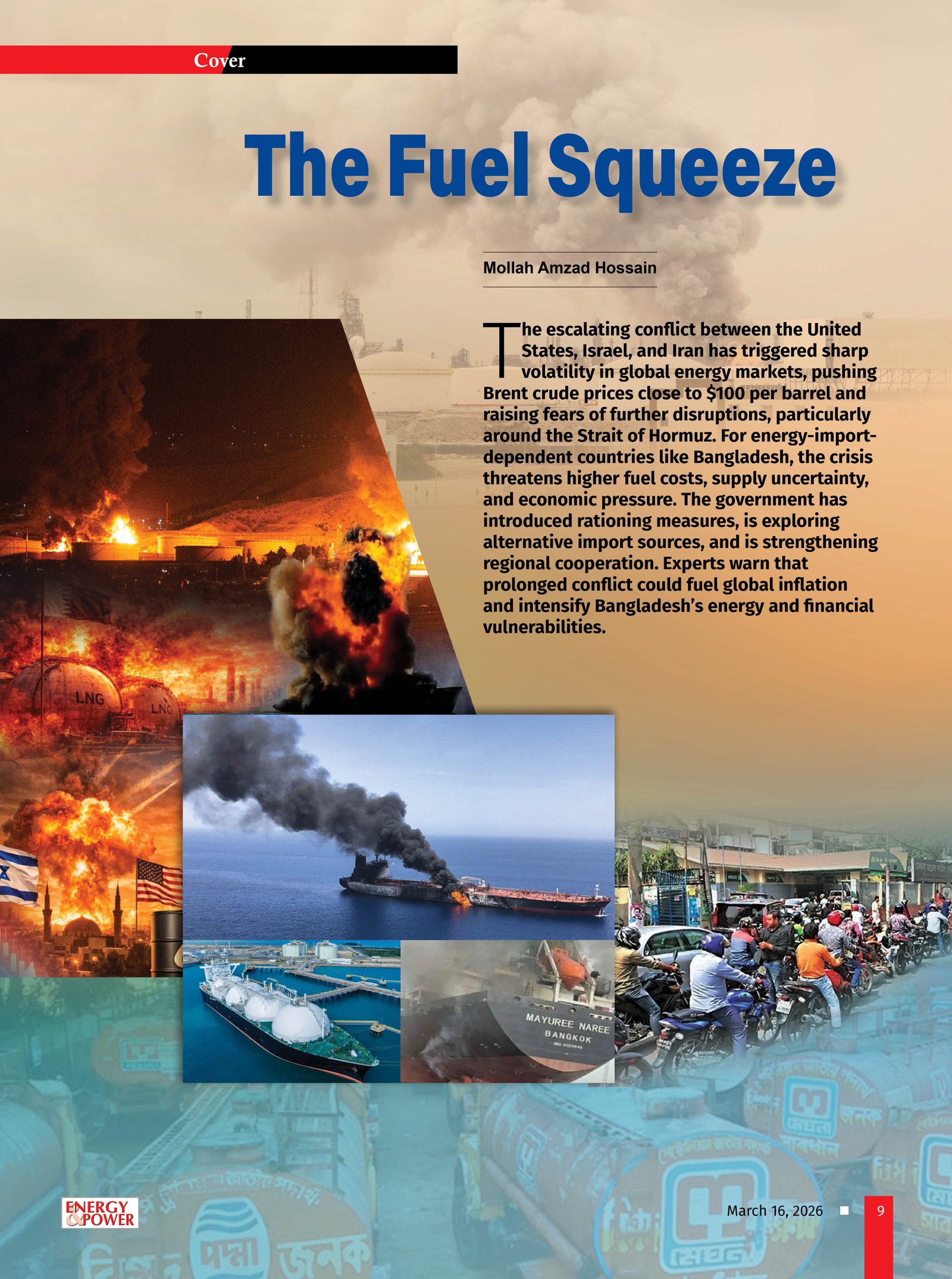
The conflict between the United States and Israel on one side and Iran on the other has plunged not only the Middle East but also much of the world into uncertainty. Governments everywhere, particularly in poorer and emerging economies like Bangladesh, are increasingly anxious about what lies ahead as the war sends shockwaves through global energy markets.
Within just 11 days of the conflict, the price of Brent crude jumped sharply, rising from around $70 a barrel to nearly $100. The surge reflected immediate fears that fighting in one of the world’s most important energy regions could disrupt oil supplies and global trade.
Prices eased somewhat after U.S. President Donald Trump said at a press conference that the war with Iran might end quickly. Following his remarks, Brent crude slipped to about $90 per barrel and then dropped further to around $88 by the 12th day of the conflict. Even so, the broader energy market has not returned to normal. The higher costs of natural gas, shipping, and insurance—pushed up by the conflict—remain firmly in place.
International media reports suggest that the fighting has already disrupted oil and gas production across parts of the Middle East. Meanwhile, restrictions and disruptions around the Strait of Hormuz, one of the world’s most critical shipping routes for energy, have created a serious bottleneck for transport. As a result, prices of refined petroleum products in global markets have nearly doubled.
Analysts warn that even if the fighting stops soon, the recovery of energy markets will not be immediate. Much will depend on how quickly oil-producing countries can restore production and normalize transportation routes. Adding to the concern, Qatar’s energy minister recently cautioned that if the conflict drags on for several more days, crude oil prices could surge to as high as $150 per barrel.
Impact on Bangladesh
The impact of the war has prompted Bangladesh and several Asian countries to adopt precautionary measures. In Bangladesh, the introduction of fuel rationing has created anxiety among the public. Rationing has also begun in the electricity and gas sectors, and austerity measures have been introduced across the board to reduce energy consumption.
Countries such as China and India have also taken various precautionary steps. In Bangladesh, the government has formed a seven-member committee led by Finance Minister Amir Khasru Mahmud to address the potential economic and energy impacts of the Middle East conflict. The Power Division has begun exploring alternative sources and making preparations to cope with possible shortages of fuel, gas, and electricity.
However, Bangladesh is highly dependent on imported energy and electricity, and the sector is already under significant financial pressure due to large outstanding payments. This has created a major challenge for the newly installed government. Alongside domestic preparations, authorities are closely monitoring developments in the conflict.
War Developments and Energy Market Impact
Despite the killing of Iran’s Supreme Leader Ayatollah Ali Khamenei in a U.S. attack, Iran has not backed down. Instead, the country has appointed his son, Mojtaba Khamenei, as the new Supreme Leader. Analysts believe the move signals that Iran’s power structure is not retreating under military pressure but is rapidly reorganizing itself to continue resistance.
This political escalation has directly affected global energy markets. Fears of a prolonged conflict, uncertainty around the Strait of Hormuz, and disruptions in supply pushed global oil prices up by nearly 30 percent at one point. Brent crude briefly climbed to about $100 per barrel before easing slightly to above $88.
Economists warn that the situation is reminiscent of the Middle East oil crisis of the 1970s. If the conflict is not brought under control quickly, the shock to energy markets could fuel global inflation and deepen economic uncertainty.
Following the appointment of the new Iranian leader, the prospects for a political resolution appear even more distant. The prolonged conflict could therefore have long-term negative effects on the global economy.
U.S. President Donald Trump criticized Iran’s decision to appoint Mojtaba Khamenei as Supreme Leader, calling it a “big mistake” in an interview with NBC News. Earlier, he had described him as a “lightweight.”
Strait of Hormuz Crisis
The geopolitical situation has reached a point where the path to political compromise is narrowing, while the risk of a prolonged conflict is increasing. At the same time, global energy markets are facing a major shock.
With the Strait of Hormuz effectively closed, the global supply of oil and liquefied natural gas (LNG) has been severely disrupted. Nearly one-fifth of the world’s oil and seaborne gas shipments pass through this route. Due to the war, tanker movements have almost stopped, and some producers are being forced to reduce production because their storage capacity has reached its limits.
Iran appears to be using the closure of the Strait of Hormuz as a strategic pressure tactic by effectively halting energy flows through the route—a move that could have severe consequences for the global economy.
Risk of Global Inflation and Economic Slowdown
As a result, international oil prices rose sharply. Although prices have eased slightly, they remain above $88 per barrel. Economists warn that if oil prices climb back to $100 or more, it could trigger a new wave of global inflation.
Major economies could face the combined pressure of economic stagnation and high inflation—a situation known as stagflation.
Many economists say the current situation recalls the 1973 oil crisis, when Arab oil-producing countries imposed an embargo against the United States and its allies following the Arab-Israeli war. Oil prices surged dramatically, causing fuel shortages, long queues at petrol stations, and disruptions in industrial production across Western countries. The crisis triggered global inflation, economic recession, and major shifts in energy policy, prompting many countries to develop alternative energy sources and strategic petroleum reserves.
A Fragile Global Economy
According to economists, the global economy is already struggling with multiple shocks, including the post-COVID recovery, the Russia–Ukraine war, supply chain disruptions, and trade tensions. If the Middle East conflict leads to a prolonged energy crisis, it could trigger another wave of inflation and push the fragile global recovery back into danger.
Analysts also warn that even if the war ends soon, it will take time for energy production and transportation systems to return to normal. Several ongoing energy expansion projects have already been suspended, which could create further challenges in meeting the growing global demand for LNG in the coming years.
Bangladesh Seeks Energy Supply Support from India and China
Recently, India’s High Commissioner Pranay Verma and China’s Ambassador Yao Wen met with Finance and Planning Minister Amir Khasru Mahmud. After the meeting, the minister and the two diplomats spoke to the media.
The finance minister said the government is trying to expand cooperation not only with India and China but also with other energy-supplying countries to ensure the country’s energy security. “Energy security is extremely important for us. Therefore, wherever opportunities exist, we are seeking cooperation,” he said, adding that discussions with international partners are ongoing.
After the meeting, Chinese Ambassador Yao Wen said Bangladesh and China would work together to address energy challenges and strengthen cooperation in this sector.
Earlier, India’s High Commissioner also met the finance minister, where energy cooperation was discussed along with other issues. After the meeting, the envoy told journalists that India would provide all possible assistance in the energy sector if Bangladesh requested it.
Meanwhile, Bangladesh has been importing diesel through a pipeline from India’s Numaligarh Refinery since March 2023. Under the agreement, Bangladesh is expected to import 180,000 tonnes of diesel annually through the pipeline. There are also initiatives to increase the amount of diesel supplied through this route.
In addition, under a government-to-government (G2G) arrangement, Indian Oil Corporation (IOC) has been supplying refined fuel to Bangladesh since 2022. Efforts are underway to increase the supply of different types of fuel through IOC by 2026. At the same time, Bangladesh has requested the lifting of sanctions to allow oil imports from Russia. The United States has already granted India a 30-day exemption for importing Russian oil.
No Energy Shortage, Says State Minister
State Minister for Power, Energy and Mineral Resources Anindya Islam Amit said on March 10 that there is currently no shortage of fuel in the country.
He noted that the crowds at filling stations are mainly for petrol and octane, although petrol is produced entirely within the country and most octane is also produced domestically. He added that the government currently has no plans to increase fuel prices.
The state minister said there is no rational reason for panic buying at filling stations, though he acknowledged that people’s concerns are understandable. “There is no supply crisis in March, and preparations are underway to ensure supply for April and May,” he said.
He also mentioned that the limit for fuel purchases by motorcycle ride-sharing drivers has been increased from two liters to five liters to ease their concerns.
Amit further said that Bangladesh is exploring alternative sources of oil imports from Africa and the United States to reduce reliance on the Middle East. The government has also informally requested India to increase its oil supply to Bangladesh.
Fuel Supply and BPC Preparations
The Energy and Mineral Resources Division believes there will be no fuel shortage in March. However, if the war continues, imports could be disrupted, and shipments may be delayed.
According to sources at the Bangladesh Petroleum Corporation (BPC), an average of 15 fuel-carrying ships arrive in Bangladesh each month. Since the outbreak of the war, however, shipments have not been arriving on schedule. This month, 16 vessels carrying fuel are expected to arrive. By March 10, six ships had already arrived, while three more were expected by March 13. Suppliers have confirmed that another seven vessels should arrive before March 31, although some shipping schedules remain uncertain.
Around 20 percent of global energy supplies pass through Iran’s Strait of Hormuz, and most of Bangladesh’s fuel shipments travel through this route. Iran closed the Strait two days after the war began. Because of security risks, only a limited number of ships are currently passing through each day.
The Bangladesh government has requested Iran to allow Bangladeshi cargo vessels to pass safely. Iran has assured that it will not obstruct such shipments. If shipments through the strait continue, fuel supply to Bangladesh may improve.
There is no supply shortage in March, but the government is preparing for April and May while also exploring alternative import sources from Africa and the United States. Bangladesh has also informally requested India to increase oil supplies.
Diesel Imports from India
According to BPC sources, the corporation signed an agreement with Numaligarh Refinery Limited on October 22, 2017, to import diesel via pipeline from India. Under the agreement, 120,000 tonnes of diesel are expected to be supplied this year, with an additional 60,000 tonnes as a possible extra supply, although this is not mandatory.
Between January and June, Bangladesh is expected to receive 60,000 tonnes of confirmed supply and an additional 30,000 tonnes. Each shipment typically consists of 5,000 tonnes of diesel, which corresponds to the storage capacity of the receiving facilities connected to the pipeline.
BPC officials also said that transportation costs for fuel oil have increased due to the Middle East war, and oil tankers are becoming harder to secure.
However, transporting oil through the pipeline from India costs about $5.50 per barrel (159 liters), making it cheaper. So far this year, 10,000 tonnes of diesel have already been delivered through two pipeline shipments.
BPC also imports fuel from Indian Oil Corporation Limited (IOCL). From January to June this year, Bangladesh is expected to receive 105,000 tonnes of fuel, including 20,000 tonnes of diesel, 50,000 tonnes of furnace oil, 25,000 tonnes of octane, and 10,000 tonnes of jet fuel, which are transported by sea.
Proposal to Increase Oil Imports from India
Due to the global energy crisis, BPC sent a proposal to the Energy Division on March 8 to increase oil imports from India. The proposal suggested importing 20,000 tonnes of diesel in four phases in March and 25,000 tonnes in five phases in April through the existing pipeline. Similar quantities could also be imported in the following months.
In addition, considering the relatively shorter distance, Bangladesh could request India to supply 120,000 tonnes of diesel through four ships, each carrying 30,000 tonnes, via sea routes.
Bangladesh produces 100 percent of its petrol domestically, while about 50 percent of octane is produced locally. The main concern is diesel. Around 70 percent of the total fuel supplied by BPC each year is diesel, which is widely used in industry, agriculture, freight transport, and passenger transport. Therefore, any disruption in diesel supply could lead to a serious crisis.
Before the war began, the global price of diesel was about $88 per barrel. It rose sharply to $146 per barrel last Sunday (March 8). To ensure an uninterrupted supply and import diesel at comparatively lower prices, Bangladesh is considering alternative sources.
Under existing agreements, crude oil is imported from Saudi Arabia and the United Arab Emirates. After refining, Eastern Refinery Limited (ERL) supplied 732,000 tonnes of diesel in the last fiscal year. However, this supply has been halted since the start of the war. With current reserves, ERL can continue refining oil until the middle of next month.
Refined petroleum products are also imported from Singapore, China, Malaysia, Indonesia, the UAE, Kuwait, Thailand, Oman, and India. Alongside these sources, the government is now searching for additional alternative suppliers.
Gas Demand and Supply Preparations
Domestic gas production and supply in Bangladesh have been steadily declining. Current domestic production stands at around 1,700 million cubic feet per day (MMCFD). With 1,000 MMCFD of imported LNG, the total supply reaches about 2,700 MMCFD, leaving a shortfall of about 1,300 MMCFD.
To maintain a normal supply, Petrobangla had planned to import 15 LNG cargoes in March, of which five cargoes have already been confirmed. However, due to the war, long-term LNG supply has become uncertain. As a result, Petrobangla purchased two LNG cargoes from the spot market at $24 and $28 per unit.
Despite these efforts, fears of a gas shortage remain. Gas supply to fertilizer factories has been suspended, and gas rationing has started in electricity generation.
Typically, Petrobangla supplies about 1,200 MMCFD of gas for electricity generation during the summer, which is already about half of the Bangladesh Power Development Board’s (BPDB) demand. This year, however, supply may not exceed 1,000 MMCFD, and the war could reduce it even further.
Energy Crisis and Power Sector Management
Summer has already begun, and even before the war, ensuring a load-shedding-free electricity supply was a major challenge for the new government.
Although the country’s installed generation capacity is over 29,000 megawatts, there are challenges related to fuel supply and large outstanding payments owed to power producers. This summer, peak electricity demand may reach around 18,500 megawatts, making it difficult to meet demand during wartime conditions.
Currently, outstanding payments in the power sector amount to around Tk 46,000 crore.
Sources say that while prices of other fuels have risen due to the war, coal prices have not yet been significantly affected. Bangladesh has about 7,000 megawatts of coal-based power generation capacity. However, due to financial constraints in importing coal, power plants last year operated at only 56 percent plant load factor.
This year, it is considered necessary to import coal in full according to demand so that coal-fired plants can operate at more than 80 percent capacity, potentially generating around 6,000 megawatts of electricity.
Gas-based power plants have a capacity of over 12,000 megawatts, but due to the gas shortage, they may produce no more than 5,000 megawatts, as the average gas supply is expected to remain between 900 and 950 MMCFD.
Electricity imports from India, including power from the Adani coal-based project, currently exceed 2,700 megawatts. If payments are maintained on time, Bangladesh may receive up to 2,500 megawatts from India.
Even then, the country could face a power deficit of around 5,000 megawatts during peak demand.
Bangladesh also has around 6,000 megawatts of furnace oil–based generation capacity. However, even if overdue payments are cleared, operators may not be able to supply electricity at full capacity. Meeting peak demand will therefore remain a major challenge.
Average electricity demand is about 15,000 megawatts, which the system can manage, but private furnace oil–based power plants currently have outstanding dues of about Tk 14,000 crore. The Independent Power Producers Association of Bangladesh (BIPPA) has repeatedly warned that without clearing these payments, they will not be able to import fuel and generate electricity.
A meeting between the Power Division and BIPPA was held on March 10 regarding the payment issue. Although BIPPA requested Tk 1,500–2,000 crore to be paid before Eid, no response was given by the government.
Currently, the BPDB incurs a loss of more than Tk 5 per unit of electricity sold. If fuel prices increase further due to the war, the current generation cost of Tk 12.10 per unit will rise even higher. As a result, concerns are growing about maintaining a stable electricity supply during the summer and irrigation seasons.
Conclusion
Bangladesh relies heavily on imported energy and electricity to keep its economy running. Under normal circumstances, if global prices remain stable, the country needs roughly $2 billion each month to pay for fuel imports and settle debts linked to the power and energy sector. But if the war drags on and global prices rise further, that monthly bill is bound to increase, putting even greater financial strain on the country’s newly formed government.
Bangladesh has faced similar challenges before. After the global energy crisis of the 1970s, the country placed strong emphasis on exploring its own energy resources. Experts now say that while managing the immediate pressures created by the current conflict, Bangladesh must also move quickly to strengthen its long-term energy security. That means accelerating exploration of domestic gas and coal resources and expanding renewable energy projects with both local and foreign investment.
At the same time, the country needs to gradually reduce its heavy dependence on energy imports from the Middle East and diversify its supply sources. The government has already begun taking steps in that direction.
Energy specialists also stress that during periods of global crisis, strict conservation measures become essential. The government will need to enforce greater efficiency in the power and energy sectors, while consumers must also play their part by using electricity and fuel more responsibly. Without such collective effort, the rising cost of energy could place an even heavier burden on Bangladesh’s economy.
Download Cover As PDF/userfiles/EP_V_23_19_Cover.pdf