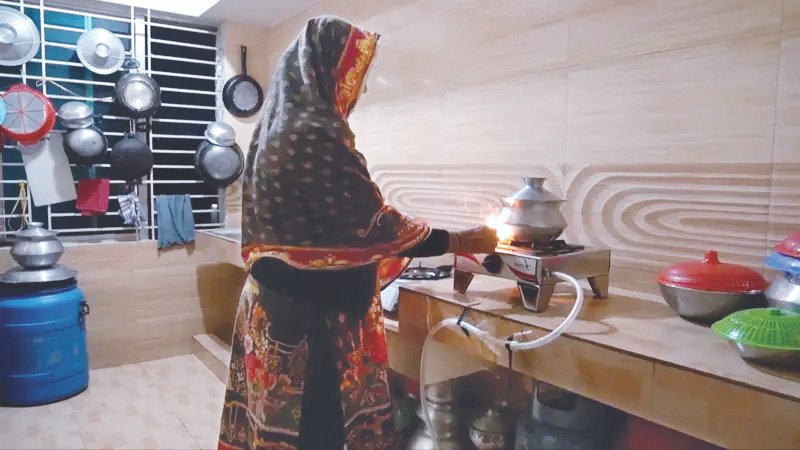
Dhaka, the overcrowded capital city of Bangladesh, offers more troubles to its nearly 20 million residents than comfort. High cost of living, persistent traffic jams, air and sound pollution, a dilapidated public transport system are some of the life-crippling woes. Add to these the gas crisis that has recently hit the kitchens of households and restaurants, as well as auto gas stations.
Most Dhaka dwellers rely on pipeline gas and LNG cylinders for cooking their meals. Last Thursday (January 8), residents across the city woke up to find their kitchens without pipeline gas. Bulbuli Akthar, a housemaid at Uttara, first thought her employer had forgotten to refill the gas card. Her employer soon discovered that the pipeline gas disappeared from the entire Uttara, a rare gas outage for the area. She tried to order breakfast from restaurants only to hear: We are also without gas and could not prepare any food items. She finally sought help from her neighbor having an electric stove to cook her breakfast and lunch.
“It was a tough day for us,” says homemaker Hasina Akthar, who has a family of eight. “The worst thing was that we had no prior notice from the gas distribution company, Titas, about the outage.” Later, she learned that the trouble was caused by an accident-related leak in Titas's pipeline beneath the River Turag. It took hours for the repair of the leak, but it did not improve the supply as a valve explosion in the pipeline in Sher-e-Bangla Nagar triggered a further outage in the areas, including Mirpur, Shaymoli, and Dhanmandi.
The outage came on a day when the suppliers of LPG cylinders stopped the supply due to the demand that the authorities raise the regulated price of the cylinder gas. They cited a shortage of supply due to the unavailability of ships for LPG imports. It was like a pair of twin missiles hitting the city’s gas consumers.
Not all Dhaka residents can afford pipeline and LPG cylinders. The poor people manage with alternative fuel like straw, kerosene stoves, and fallen leaves gathered from under trees. But those who use either pipeline gas or LPG cylinders are still having tough times with twin problems: the LPG cylinders are selling for more than double the price fixed by the regulators, and the erratic supply of pipeline gas. For many, it meant spending more on cooking gas and even on buying meals from restaurants. Some are rushing to markets to buy electric stoves, another item whose use will increase the electricity bill. There is no good news for the city residents struggling with long-persistent high inflation and a host of other service-related issues.
When a 12-kg LNG cylinder sells for Tk2,400 to Tk 2,500, nearly double the regulated price of Tk1,306, there can be no consolation. Living cannot be easy when the pipeline gas dries up without any notice. According to figures available from Petrobangla, Dhaka city has been witnessing a steady decline in the daily average supply of gas for cooking. For example, in the first ten days of January, the average daily supply has currently dropped to 2,596 million cubic feet (mmcfd) from 2,826 mmcfd in 2022. This is happening even though the import of LNG has increased in recent times. In 2025, the government imported a total of 109 cargoes of LNG compared with 94 in 2024. The Daily Star newspaper quoted Fouzul Kabir Khan, adviser to the power, energy, and mineral resources, the pipeline gas supply has increased during the tenure of the interim government. Responding to the issue of volatility in the LNG supply, the adviser told the newspaper the government is exploring importing on a government-to-government basis, cutting down reliance on the private sector, which currently imports 98 percent of LPG or Liquefied Petroleum Gas.
Download Column As PDF/userfiles/EP_23_15_Column.pdf