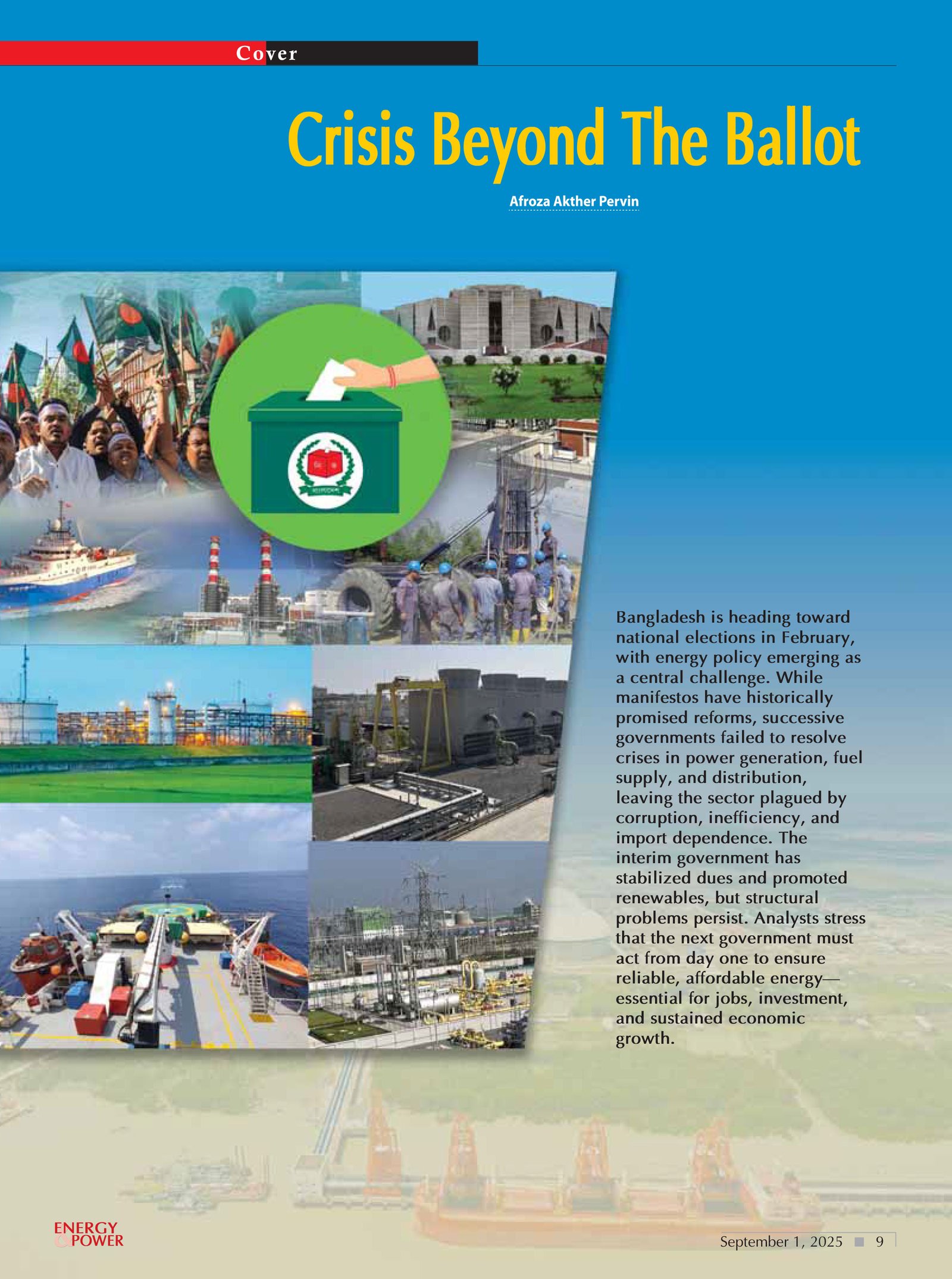
Bangladesh is now on the road to elections. The national parliamentary polls are set for February next year, following Chief Adviser Professor Muhammad Yunus’s announcement in a televised address. Since then, the upcoming election has dominated public debate.
The announcement came shortly after Yunus delivered the July Declaration at the South Plaza of Jatiya Sangsad Bhaban. The BNP welcomed both moves, but Jamaat and the newly formed NCP dismissed the declaration as falling short of the nation’s expectations. Still, analysts agree that politics is now firmly focused on the ballot box.
Yet, the election is only part of the story. Whoever forms the next government will inherit daunting challenges—from reviving an economy weakened by more than 15 years of misrule to breathing life back into the energy sector, the backbone of the economy. Experts stress that parties should not only prepare for the campaign trail but also start shaping concrete strategies, policies, and action plans to tackle these urgent issues.
Following the fall of General HM Ershad amid mass movements, the 1991 national parliamentary election was held in a democratic environment. Ahead of that election, the BNP, Awami League, and all other major parties issued manifestos, which, alongside other policy areas, emphasized the energy and power sector as a priority. In 1991, major parties laid out their core policies for energy and power sector development, briefly outlining their strategies for achieving those goals.
This practice continued in the 1996, 2001, and 2008 elections, with each party publishing action plans for energy and power. However, the elections of 2001 (February by-election), 2014, 2018, and 2024 lacked broad participation, and therefore, manifestos were not the focus of public discourse. Even when parties came to power through participatory elections, they often failed to implement the pledges made in their manifestos for the energy and power sector. Policy inconsistencies, reversals of strategies pursued by previous governments, and a lack of coordination in sectoral development have remained persistent issues.
For instance, almost every party except the leftists pledged to explore and develop the country’s coal resources, yet in the past 30 years, no concrete steps have been taken toward domestic coal exploration and extraction. Similarly, except for the 1996–2001 term, while successive governments prioritized increasing power generation capacity, they neglected fuel supply, transmission, and distribution systems.
In its 2008 manifesto, the Awami League pledged to ensure electricity for all by 2020. Benefiting from its uninterrupted rule—amid opposition boycotts in the subsequent three elections—Awami League indeed achieved universal electricity access. However, critics argue that this was done without improving the quality of transmission and distribution systems.
After the caretaker government assumed office in 2007, corruption and irregularities in the energy and power sector under previous governments were investigated, and cases were filed. The BNP, which had governed earlier, was widely seen as having failed to deliver in the energy sector. It made no major achievements in domestic oil and gas exploration, cross-border pipeline negotiations (such as the Myanmar–India pipeline with purchase opportunities for Bangladesh), or in increasing power generation.
The BNP government also failed to resolve the Phulbari coal controversy, where leftist-led protests against open-pit mining led to fatalities. Since then, domestic coal extraction has remained frozen in debate. By the time the caretaker government took charge, the country was in the middle of a deep energy and power crisis.
To manage the shortage, the caretaker government initiated the setting up of oil-fired rental power plants, with entrepreneurs selected through competitive bidding. At that time, the current energy adviser, Dr. M. Fouzul Kabir Khan, was serving as Power Secretary, and Professor Dr. M. Tamim, now Vice Chancellor of IUB, was serving as Energy Adviser. To cope with the gas shortage, gas connections for industry were first suspended in Chattogram, and later across the country, including for domestic cooking.
Despite installing new power plants, the electricity supply remained well below demand. Installed capacity was just above 5,000 MW. A senior engineer who had held a top position under the BNP government alleged that the BNP had embezzled Tk 42,000 crore from the power sector. Although this allegation lacked accuracy, the Awami League used it against the BNP after winning the 2008 election, continuing to accuse them of corruption.
Once in office in 2009, the Awami League pursued various programs in the energy and power sector under the banner of “crisis management.” The government argued that the conventional tender process could not deliver timely solutions, and so introduced the Quick Enhancement of Electricity and Energy Supply (Special Provisions) Act, 2010, allowing projects to be undertaken without tenders. Despite sharp criticism from civil society and experts, the Awami League government kept the law in force until it was ousted.
According to Professor M. Shamsul Alam, energy adviser to the Consumers Association of Bangladesh (CAB), this law marked the beginning of widespread irregularities in the energy and power sector. It destroyed competition, led to unnecessary projects, and opened the door to financial corruption.
As a result, one power plant after another was established under this law, but fuel supply, transmission, and distribution were not ensured. Over the past 15 years, electricity and energy prices—especially gas prices—have tripled to quadrupled at the consumer level.
On the other hand, the National White Paper Committee’s report on the country’s power and energy sector stated that during the Awami League government’s tenure, at least $6.0 billion worth of corruption took place in the sector. During that period, a total of Tk 115,000 crore was paid in capacity charges for power generation. According to the committee’s observation, Tk 36,000 crore (about $3.0 billion) of that was an unnecessary capacity payment.
Energy expert Professor M. Tamim remarked that by following flawed policies, the government only focused on expanding generation capacity, while neglecting investments in transmission and distribution. As a result, they failed to ensure a system capable of supplying uninterrupted, quality electricity. At the same time, no concrete measures were taken to secure gas supply for power generation and industry, leading to an acute shortage. Without ensuring domestic coal extraction, a series of coal-fired power plants were set up, while reliance on imported electricity increased. Currently, 55% of the country’s power and energy supply depends on imports, which has had a significant impact on prices. Moreover, essential infrastructure for coal and LNG imports could not be established.
Meanwhile, although numerous renewable energy projects were approved toward the end of the government’s term, during the past 15 years, no coordinated initiative was undertaken for the development of this sector.
Against this backdrop, following the August 5, 2024, student-led uprising, the fall of the Awami League government, and Sheikh Hasina’s asylum in India, the weaknesses and damages in the power and energy sector began to surface. While private investors had invested in the power generation sector by leveraging government policies, they now face serious risks—being seen as partners in the Awami League government’s corruption.
At the time of the government’s fall, total outstanding dues in the power and energy sector had exceeded $5.0 billion, while the gas shortage continued to worsen. After the Russia–Ukraine war, the government even failed to supply enough electricity to meet summer demand. In this situation, the interim government began work to restore discipline in the power and energy sector.
Over the past year, its biggest success has been reducing the sector’s outstanding dues to a normal level. Despite differing opinions and criticisms, the interim government canceled the contract for a third FSRU, along with negotiations for a fourth FSRU and RLNG imports from India. Similarly, 37 letters of intent (LOIs) for solar power plants were revoked, replaced with a tender call for grid-connected solar projects, though the response has reportedly been poor.
In contrast, the government has announced the Renewable Energy Policy 2025, setting targets of 20% renewable contribution by 2030 and 30% by 2040. Alongside this, Chief Adviser Dr. Muhammad Yunus launched a National Rooftop Solar Program, directing all government buildings to install rooftop solar, with schools and hospitals included under the initiative. The declared target is to install 3,000 MW of rooftop solar capacity on government buildings by December, although the official policy document by SREDA places the target between 2,000–3,000 MW.
However, a recent IIEEFA study claims that the target is unrealistic. Lead author Shafiqul Alam argued that under the net metering guidelines, government rooftops do not have sufficient space to accommodate such capacity, and the timeline is too short to achieve it.
The interim government has continued the 150-well drilling program for oil and gas exploration, launched in 2022 and scheduled to be completed by 2028. So far, 20 wells have been drilled, adding 85 MMCFD of new gas to the grid. However, no new tenders have been floated for additional FSRUs. A land-based LNG terminal at Matarbari is being pursued under PPP.
In addition, the government has started reviewing power purchase agreements (PPAs) to reduce tariffs. As part of this, tariffs at some public sector power plants have been adjusted, and the same principle is being gradually extended to the private sector. The government has also announced a goal to reduce power sector expenses by Tk 11,000 crore.
Still, no initiatives have been taken to specifically address corruption in the power and energy sector, as recommended by the White Paper Committee. A few committees are working on this, however, and recently the Anti-Corruption Commission (ACC) ordered private power plant owners to submit full financial statements of their income and expenditures. Many believe this is part of an effort to identify corruption more concretely.
Overall, the interim government has essentially carried out day-to-day operations in the power and energy sector, without initiating any new long-term projects. With elections scheduled for February, it has little scope to take up new initiatives.
This summer, while there was no major crisis in power supply overall, industries continued to face shortages. Grid-dependent industries regularly suffer from power outages, load-shedding, and disruptions, hampering production. Furthermore, no new gas connections have been issued in the past eight months.
Speaking to Energy & Power, Dr. Masrur Riaz, Chairman of Policy Exchange Bangladesh, said that due to the power and energy crisis, industrial production has been disrupted by 25–40%, depending on the sector, and no new investments are being made. At a recent monthly seminar organized by PRI, it was stated that the two biggest obstacles to the economy and investment are the energy crisis and political instability. At the event, Anwar-ul-Alam Chowdhury, President of the Bangladesh Chamber of Industries, said the energy crisis is the biggest barrier to sustaining industrial production. Many industries have already shut down, and many more are under severe pressure. Thus, without ensuring a reliable power and energy supply, there is no way to keep industrial production going.
Overall, it can be said without hesitation that the country’s current power generation capacity exceeds demand. While the present peak demand is around 17,000 MW, the installed generation capacity is 27,000 MW. Of this, about 20–22 percent is furnace oil-based, which is very costly to operate. Meanwhile, about half of the gas-based power plants remain idle due to gas shortages.
By 2026, the first unit (1,200 MW) of the Rooppur Nuclear Power Plant is expected to begin commercial operation, followed by the second unit (also 1,200 MW) in 2027. However, during this period, at least 3,000 MW of capacity—including oil-based plants—will be retired as their lifespans or contracts expire. On the other hand, although coal-fired plants have a combined capacity of 7,000 MW, the full potential cannot be utilized due to inadequate infrastructure.
Sector insiders project that by 2028, electricity demand will reach 22,000 MW, and by 2030, it will rise to 25,000 MW. Therefore, for the political party or coalition forming the government after the February election, one of the biggest challenges will be to take effective measures in the very first year to prevent the power sector from sliding into a fresh crisis. At the same time, the transmission and distribution systems must be made reliable to ensure an uninterrupted supply of quality electricity.
Over the past five years, grid power demand in the industrial sector has remained limited to 29%, while residential usage now accounts for 56%. Thus, increasing electricity use in industries will be a crucial challenge to reduce subsidies in the power sector.
Another pressing issue is ensuring primary energy supply for industry and power generation. Bangladesh’s domestic resources are very limited—only a modest reserve of natural gas and a comparatively larger coal reserve. Given the current state of gas supply, the shortage is expected to deepen further from next year. To mitigate this, the ongoing program to drill 150 wells by 2028 with domestic financing must be continued and completed on schedule. Still, with domestic gas production already down to 1,800 MMCFD, doubts remain about whether this level can even be sustained. Production at Bibiyana, one of the country’s largest gas fields, continues to decline. Connecting Bhola gas to the national grid will therefore be a major challenge for the next government—and unless preparations start immediately, no results will be seen within the next three years.
Alongside domestic production, there is no alternative to LNG imports. Hence, work must begin on establishing two additional FSRUs, setting up onshore LNG terminals, and reviving the previously canceled initiative to import RLNG from India.
In addition to domestic oil and gas exploration, Bangladesh must take effective steps to attract foreign investment under PSCs (Production Sharing Contracts) for offshore and onshore exploration. However, investors currently lack confidence in the sector, despite the existence of a draft PSC framework. Preparations should therefore be highlighted in election manifestos, so that the incoming government can begin work immediately.
At a recent workshop, the energy advisor of the interim government stated that there is no alternative to using domestic coal if coal power generation costs are to be reduced. However, no final decision has been taken on this. Instead, a recommendation on the prospects and challenges of coal extraction is being left for the next government—a significant challenge in itself.
The development of renewable energy is now a pressing need. Bangladesh has made little progress in this area. To attract investment, lessons from neighboring countries must be leveraged to accelerate expansion. Increasing the share of renewables will also require regional cooperation, for which there is no alternative.
One of the greatest challenges for the next government will be to reduce subsidies without raising energy and electricity prices. Last fiscal year, subsidies for the power and energy sector amounted to Tk 70,000 crore, whereas the current budget allocates Tk 43,000 crore. Thus, from the very start, effective initiatives must be taken to reduce the production costs of electricity, gas, and coal. Above all, addressing these challenges requires strengthening institutions with skilled manpower, eliminating corruption, and restoring transparency at every level.
Professor Shamsul Alam has expressed hope that these preparations will be finalized through the election manifestos. He said that in discussing the necessary steps for the power and energy sector with political parties, he received no response except from the BNP.
Energy expert Mushfiqur Rahman believes that every party contesting the election should include detailed strategies and programs for the energy sector in their manifestos. That way, the government can start working immediately after formation without losing time. However, Dr. A. K. Enamul Haque, Director General of BIDS, disagrees. According to him, parties should indeed have plans, but making public pledges is unnecessary, since that could trigger a competition among parties over who promises more.
Regardless of what the election manifestos promise, any party hoping to form the next government must begin preparing now to address the power and energy crisis. Without decisive action from day one, the situation will only worsen, undermining job creation, export growth, and overall economic momentum. For Bangladesh, there is simply no alternative: the country must take immediate steps to stabilize the power and energy sector, reduce its reliance on imports, and curb subsidies without pushing prices higher. If these measures are delayed, the consequences will be severe—production will slow, new investments will dry up, and the economy will struggle to move forward.
Afroza Akther Pervin, Managing Editor, Energy & Power, Editor, Rang Berang
Download Cover As PDF/userfiles/EP_23_6_Cover.pdf