ANTALYA, Türkiye, Nov 10, 2026 — Climate-vulnerable least developed countries (LDCs) are being forced to pay twice for the climate crisis—first through the loss of lives, livelihoods and homes, and then through debt repayments for climate-related financing, according to a new analysis presented at COP31.
Change Initiative, Transparency International, the Climate Action Network South Asia-Bangladesh (CANSA-Bangladesh) and Young Power in Social Action (YPSA) have called on world leaders to expand grant-based adaptation finance, strengthen transparency and accountability, and support renewable energy investment without increasing public debt.
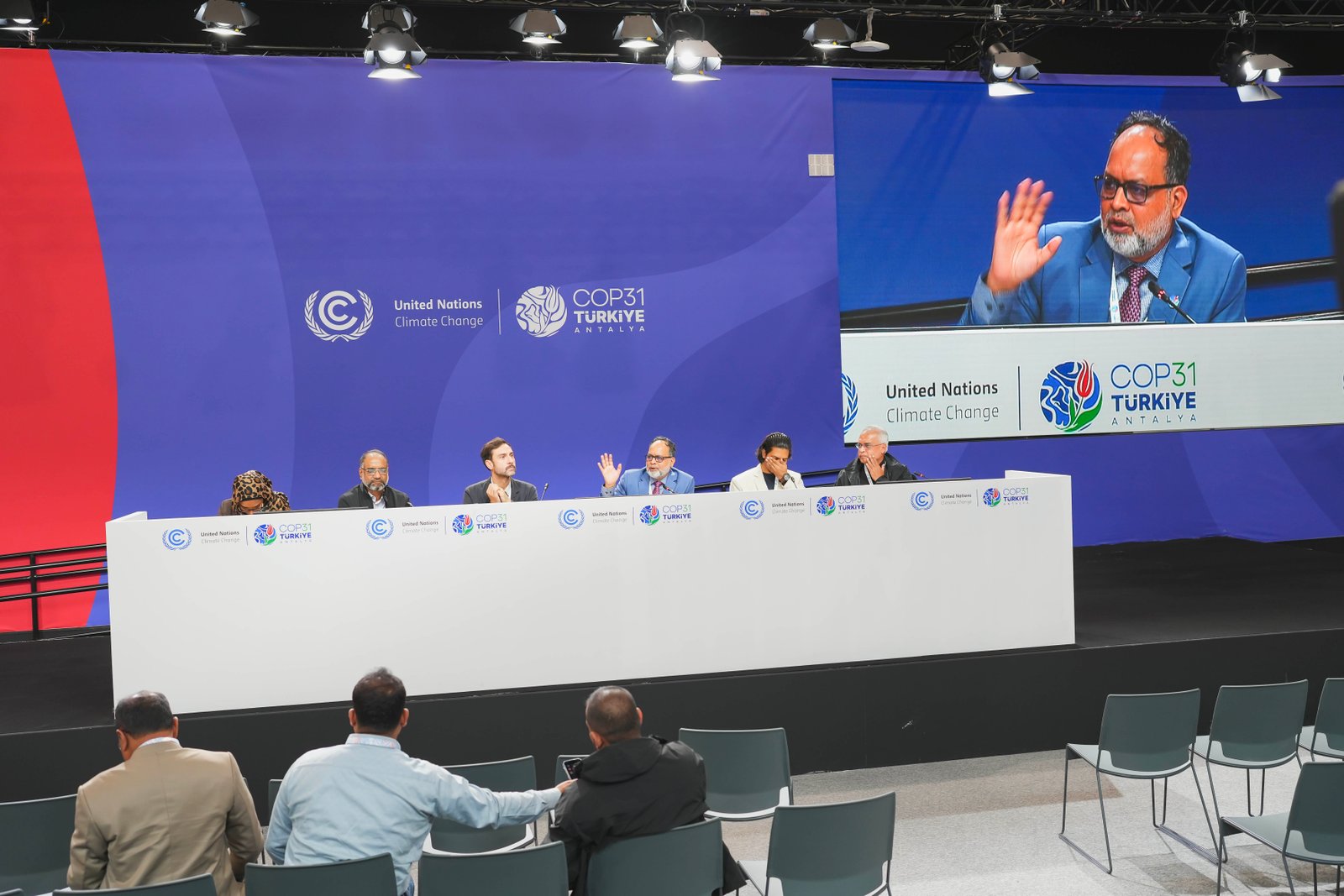
At a joint press conference titled “Breaking the Climate Debt Trap: Financing Nature-Smart Energy Sovereignty” on the second day of COP31, the organisations presented evidence of the growing mismatch between the climate finance needs of vulnerable countries and the financing terms available to them.
The event was held at Press Conference Room 2, Area D4 (Yunus Emre), at the Antalya Expo Center. M. Zakir Hossain Khan, Co-Founder and Chief Executive of Change Initiative, delivered the keynote address, while the organisation’s Research Coordinator Mofazzal Hossain presented findings on renewable energy financing.
Brice Böhmer, Climate Lead at the Transparency International Secretariat; Mohammad Shahjahan, President of CANSA-Bangladesh; and Roaa, CEO and Founder of United Beyond Borders, joined the discussion. Mohammad Arifur Rahman, Chief Executive of YPSA, delivered the closing remarks.
Debt burden outweighs climate finance
Presenting the findings, Khan said the financial burden facing climate-vulnerable countries was undermining their capacity to respond to climate impacts.
In 2023 alone, the 55 countries covered by the Climate Debt and Resilience Index (CDRI) spent US$47.17 billion on debt servicing—more than the US$33.74 billion in climate finance recorded for them over the entire 2002–2023 period. The debt-servicing figure covers all categories of external debt, rather than climate-related debt alone.
Eight countries—Bangladesh, Cabo Verde, Cambodia, Myanmar, Pakistan, the Philippines, Senegal and Sri Lanka—account for 74.3 percent of the climate loans recorded in the index. Each received more climate finance in loans than in grants.
The pressure is increasing as development assistance declines. Official development assistance fell by 23.1 percent in 2025, the largest annual drop on record, according to the figures presented at the event.
The organisations argued that the growing reliance on loans is particularly problematic for countries already facing severe climate-related losses and limited fiscal capacity.
Adaptation finance gap and accountability concerns
The speakers also highlighted the gap between climate finance commitments and actual disbursements.
Climate finance provided by developed countries increased from US$115.9 billion in 2022 to US$136.7 billion in 2024. However, only US$2.3 billion of the US$20.8 billion increase went to adaptation, while two-thirds of public climate finance continued to be delivered as loans.
According to the analysis presented, US$32.43 billion in adaptation commitments—66.1 percent of the total—had no corresponding payment record.
Khan cited a World Bank-supported coastal embankment project in Bangladesh to illustrate the consequences of the gap between promised and delivered protection. The project was initially expected to protect 100,800 hectares, but its target was later reduced to 66,012 hectares, with 65,657 hectares ultimately covered. This left 35,143 hectares without the protection originally promised.
He also questioned global spending priorities, arguing that four days of worldwide military expenditure were equivalent to a full year of public adaptation finance. According to his presentation, redirecting 40–50 percent of public fossil fuel subsidies provided by G20 countries could generate the grants needed for adaptation.
Renewable energy investment creating another debt burden
Mofazzal Hossain highlighted Bangladesh’s dependence on loans to finance its energy transition, despite the country contributing less than 0.5 percent of global greenhouse gas emissions.
According to Change Initiative’s analysis, 90.4 percent of Bangladesh’s renewable energy investment since 2000 came through loans. Of the US$2.54 billion in climate finance recorded for the country’s energy sector, US$880 million supported coal and gas power projects, including Matarbari and Bheramara.
The analysis warned that, under current financing conditions, renewable energy-related debt could reach US$105 per person by 2040, exceeding Bangladesh’s current climate debt of approximately US$80 per person across all sectors.
To address the problem, Change Initiative proposed a Renewable Energy Sovereignty Facility, a national financing mechanism for LDCs based on grants, guarantees and capped public loans.
The proposed facility would support US$7.69 billion in renewable energy investment during 2026–2030 while reducing new public borrowing from US$4.6 billion to US$800 million. It could also limit renewable energy debt to US$24 per person by 2040, a 77 percent reduction compared with the projected level under current financing arrangements.
“The issue is not an absence of money; the problem is that money comes through the wrong channels,” Mofazzal Hossain said.
He explained that development banks lend to governments, which then lend to state agencies, while those agencies extend loans to households and investors. “This debt cycle traps everyone. Renewable energy should not add to public debt,” he said.
Call for grant-based climate finance
Khan urged COP31 negotiators to agree on an initial level of adaptation grants and annual targets beginning in 2027. He called for clear separation of loans and grants in all climate finance reporting and urged countries to exclude fossil fuel projects from climate finance claims.
He also advocated establishing national renewable energy funds capable of financing clean energy development without adding substantially to public debt, with pilot initiatives beginning in Bangladesh in 2027.
“LDCs must not become victims twice over: first through climate vulnerability, and second through an unjust debt burden,” Khan said.
“The bottom line is clear: stop relabelling ODA as climate finance. Nature does not respect borders or publicity; it only responds to real human actions. Climate finance must be delivered as grants to protect ecosystems and human life,” he added.
Transparency and historical responsibility
In the moderated discussion, speakers linked the climate debt problem to transparency, accountability and the historical responsibility of developed countries.
Brice Böhmer of Transparency International warned that a lack of transparency and accountability in climate finance could create opportunities for corruption. He said corruption undermined climate policies, weakened responses to the climate crisis and allowed attacks on environmental defenders to go unpunished.
He called for civil society organisations and local communities to monitor climate investments to ensure that projects reflect local priorities. He also urged COP31 to incorporate accountability and integrity into its planned consultations on efficiency and reform.
Mohammad Shahjahan, Director of the KM4D Division at YPSA and lead of the Bangladesh chapter of CANSA, called on developed countries to meet their climate responsibilities through predictable and additional grant-based finance.
“Developed countries must stop converting climate responsibility into climate debt. They must provide new, additional, predictable and grant-based climate finance, rather than repackaging development assistance and loans as climate commitments,” he said.
Roaa, CEO and Founder of United Beyond Borders, highlighted the concerns of young people in developing countries.
“Developed countries often avoid the word ‘debt’ and prefer ‘finance’, but in reality, it is debt. Developing countries are suffering destruction caused over centuries by developed nations, yet when it comes to finance, it is called a shared collective responsibility,” she said.
She called for more grant-based financing for locally led community projects and greater accountability from countries responsible for historical emissions.
Media urged to scrutinise climate finance
In his closing remarks, YPSA Chief Executive Mohammad Arifur Rahman urged journalists to investigate how climate finance is raised, allocated and delivered.
He argued that financing models based on loans ultimately increase national debt burdens that ordinary citizens must repay.
“All climate finance must be delivered as grants, and media pressure is crucial to influence policymakers,” he said, calling for more in-depth reporting on the financial challenges facing climate-vulnerable countries.
Responding to a question about the role of the private sector in the Global South, Khan said private investment was important for technology development and manufacturing. However, he cautioned against relying on commercial markets to meet adaptation needs.
“Adaptation finance should not be left to private markets or profit motives. For renewable energy, transparent direct investment and sovereign frameworks must lead the transition, not commercial debt traps,” he said.
The organisations called on COP31 to make grant-based adaptation finance, transparent reporting and debt-conscious renewable energy investment central to the global climate finance agenda.