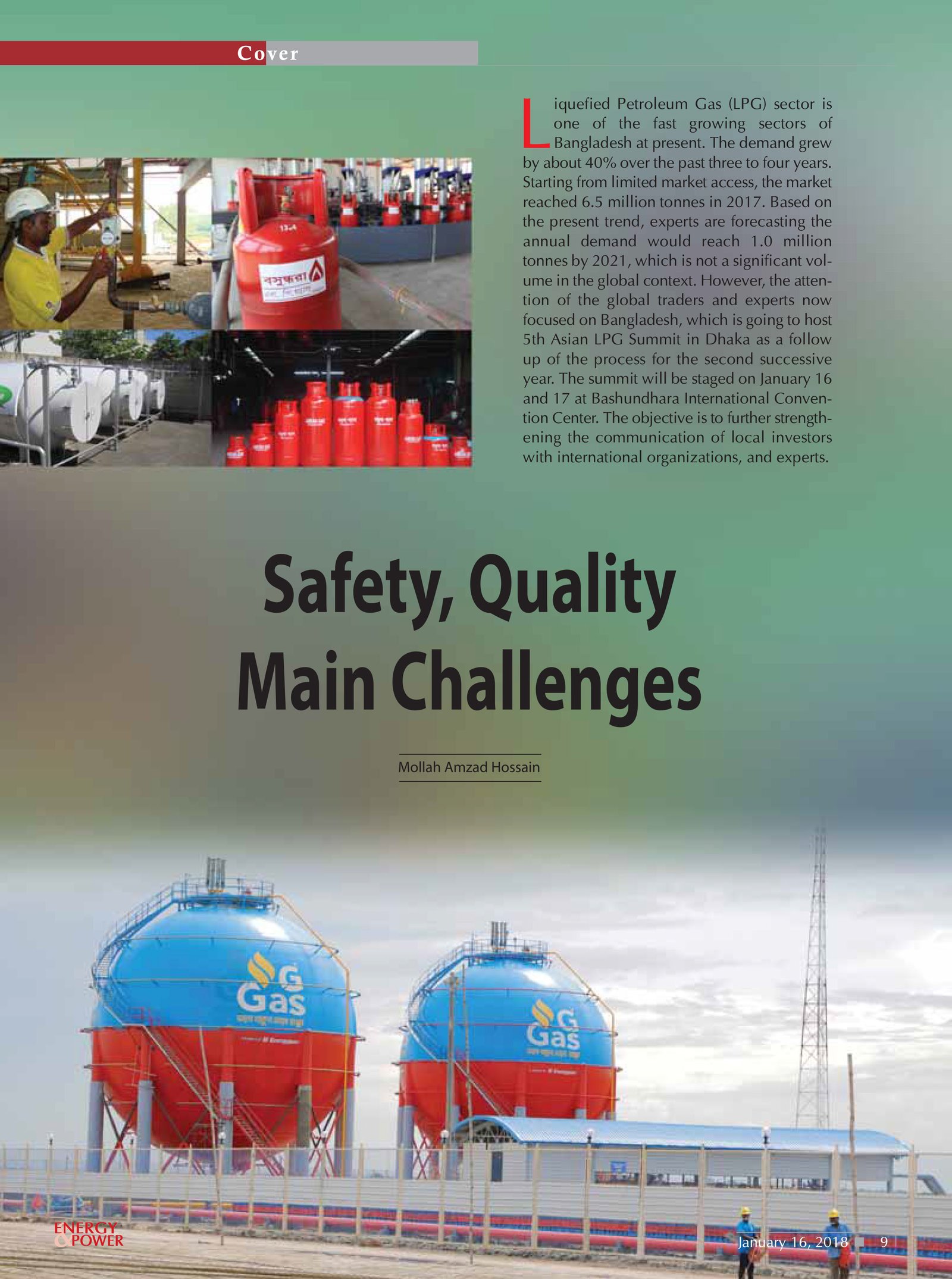
Liquefied Petroleum Gas (LPG) sector is one of the fast growing sectors of Bangladesh at present. The demand grew by about 40% over the past three to four years. Starting from limited market access, the market reached 6.5 million tonnes in 2017. Based on the present trend, experts are forecasting the annual demand would reach 1.0 million tonnes by 2021, which is not a significant volume in the global context. However, the attention of the global traders and experts now focused on Bangladesh, which is going to host 5th Asian LPG Summit in Dhaka as a follow up of the process for the second successive year. The summit will be staged on January 16 and 17 at Bashundhara International Convention Center. The objective is to further strengthening the communication of local investors with international organizations, and experts.
After liberation of Bangladesh, Eastern Refinery Limited (ERL) started producing LPG and marketing in a limited scale one of the bi-products during refining of crude oil. Subsequently, Petrobangla started producing LPG and bulk marketing from natural gas liquid. Now about 20-22 thousand tonnes of LPG come from these two sources annually. But this is very insignificant in consideration of the demand. About 6.5 lakh tonnes of LPG (Mix of Propane and Butane) is being imported annually for meeting the demand. The growing purchasing power of rural community over the past 10 years pushed up the demand for LPG as alternative fuel. LPG started becoming a popular domestic fuel option in areas outside gas franchise coverage and the demand increased remarkably over the past three to four years. The LPG demand in Dhaka, Chittagong and adjoining areas also increased following suspension of new pipeline gas connection to domestic consumers. The poor quality low-pressure supply also contributed to this.
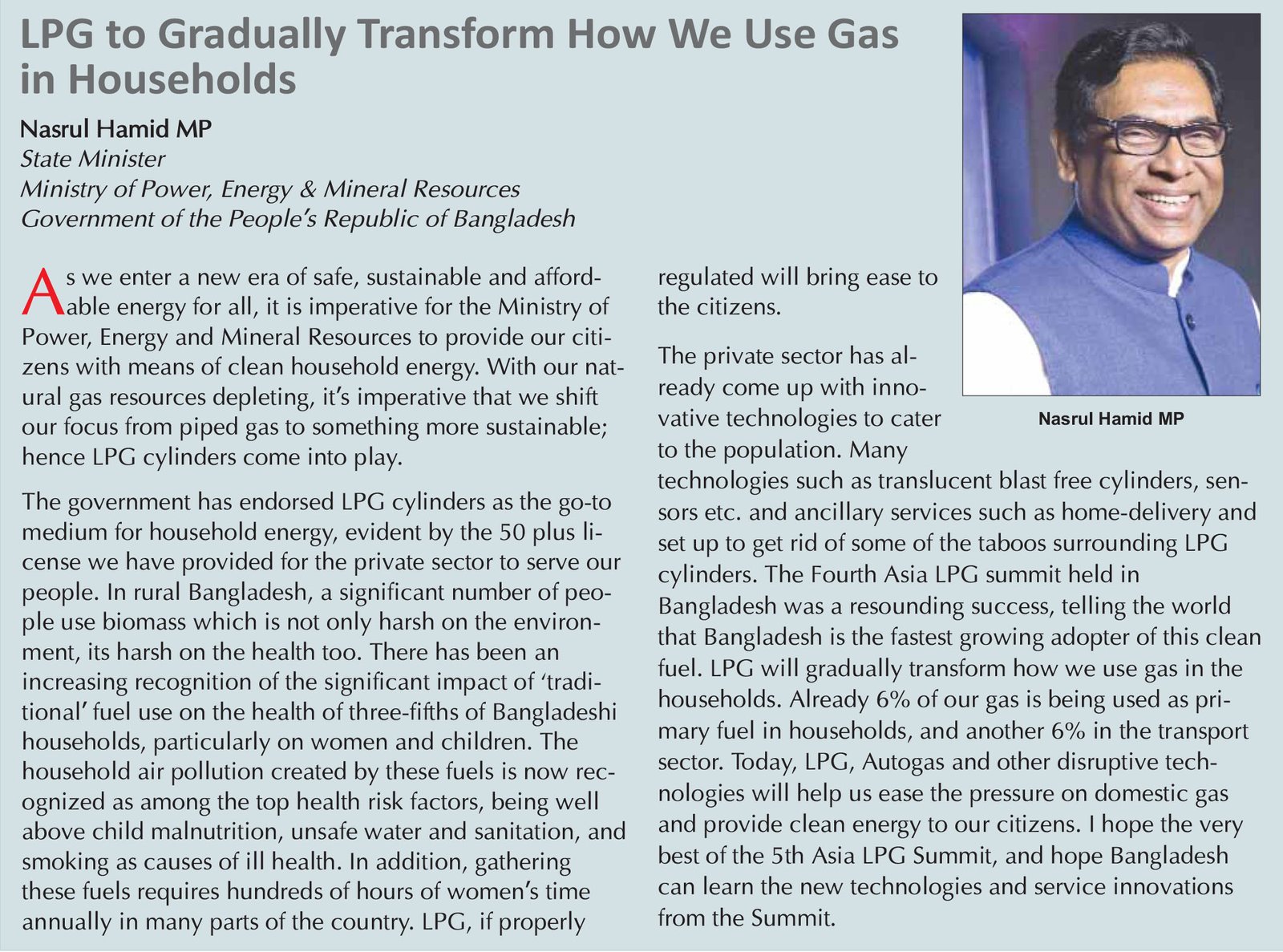
Taking all into consideration, the Energy & Mineral Resources Division (EMRD), BPC and private sector LPG companies are expecting the demand to reach 2.0 million tonnes annually by 2030. The demand may be 1.5 million tonnes in 2025. LPG use will continue beyond 2041, but the rate of increase may be slower than the period of 2018-2030. The LPG demand has increased by 40% over the past four years. The demand was 88,500 tonnes in 2012. It was 95,500 tonnes in 2013, 1,12,700 tonnes in 2014, 1,73,000 in 2015, 3,62,000 tonnes in 2016. It is expected that in 2017 the demand would grow to 4,40,000 tonnes. But surprisingly the actual demand became 6,70,000 tonnes. The demand for 2018 and 2019 was estimated at 5,30,000 tonnes and 6,50,000 tonnes. But the demand estimated for 2019 has already been exceeded in 2017. The original estimate for 2020 and 2021 was 8,00,000 tonnes and 1.0 million tonnes.
Chief Executive Officer of Laugfs Gas Md. Saidul Islam was asked whether the estimated demand of LPG in 2021 can be exceeded. He, however, mentioned that the demand growth has stalled over the past four months though it was growing at 35-40% over the past 3-4 years. When asked why it happened so, he said this year the LPG price increased by US$200 per tonne. Consequently, the operators are supplying it at cost price or at marginal profit. The operators are not much concerned for market expansion. The gradual increase of crude oil price in global market is among the reasons. The increasing trend of crude oil in global market is still being seen. It will make LPG market more volatile. Even after these, the operators are capable to meet the present demand. Four new operators -- G-Gas, Sena Kalyan, Navana and Orion -- have entered into the market. Laugfs Gas and Total have already been there. Bashundhara LP Gas is pioneer of the local private operator. Jamuna Specetech, BEXIMCO, OMERA, BM Energy and state-run BPC are also in the market. Three more companies are also waiting for coming into operation. Some 30 more companies have also been awarded the licenses.
The government has already announced that the suspension of pipeline gas connections to domestic users would continue. Despite the suspension, there are allegations that a few lakh illegal connections have been given. There are also allegations that these illegal connections have been given in Dhaka city and adjoining areas using PVC pipes under political influence. Though detection of such illegal connections and disconnection campaign by five gas distribution companies, the trend of risky but unauthorized connections have not completely eradicated. About 13% of the total gas production goes to domestic consumers. Many users are compelled to use LPG for poor quality and low-pressure supply. Another section of domestic consumers are still trying to get pipeline gas supply somehow.
Low income citizens in many places of Dhaka and other cities are also using LPG despite having connections with distribution network. Many cannot use LPG for financial constraints despite being in serious problem for arranging fuel for cooking. Monthly gas bill for a double burner connection is Tk 850. On the other hand, if they have to transfer to LPG, they have to invest Tk 6,500 at a time for all costs related to it. Many developers and consumers are expecting that the government would resume new connections for pipeline gas supply, following LNG introduction to the national grid. The government must confirm that pipeline gas supply to new domestic consumers would not be given even after LNG introduction. That will facilitate the expected growth of LPG market. Of course, the government is telling that only LPG would be used in future for domestic cooking fuel. There is no scope for any confusion.
Experts observe that the government has no study yet on the future demand of LPG. Consequently, it is not clear how many operators should be there for meeting the demand. Md. Saidul Islam thinks the government should remain satisfied with the numbers of present operators. He thinks that market would become over supplied if all the operators now given license to start commercial operation. The government must carry out study on such possible adverse impacts soon.
Dealers and distributors have lost incentive for the present stalemate situation of LPG market expansion. Many have moved out of the business at field level. Few others have entered into other business. Another irregularity is also observed at field level. Dealer of a company is supplying LPG to users of other company. Consequently, cylinders of different companies get stuck to different dealers. He then is compelled to sale cylinder at lower price.
Let us discuss about safety. Reports of LPG cylinder accidents are appearing very frequently in the media. Works are being done for creating consciousness about LPG safety among users for avoiding accidents in the different parts of the country on behalf of the operators. But it cannot be said that these are yielding results. Department of Explosives (DOE) issues license after reviewing the safety plans for LPG importing and bottling. But it is not clear at all which authority DOE, BPC or BERC should be held accountable for accidents of LPG cylinders at the users’ end. People got killed in accidents on roads during transportation of LPG cylinders last year. But no investigation into the incidents was carried out. Responding to a question as to why no report could be made about the accidents after conducting investigation, DOE mentioned about absence of experienced manpower. RPGCL issued some guidelines about LPG use. Later BERC issued detail guidelines. But no experienced manpower is available in any government agency for monitoring the use of LPG at consumers’ level.
Experts related to LPG sector are getting increasingly concerned about frequency of accidents during LPG use. The expansion and development of LPG sector would be adversely impacted if safety cannot be ensured through intensive monitoring of safe use of LPG. The LPG policy announced by Ministry of Power, Energy & Mineral Resources states about safety of LPG use. Special emphasis is given on safety of LPG cylinders. While investigating into the accidents, it appeared that inferior quality of LPG regulators and hose pipes are the reasons for accidents while using LPG for cooking. Importers in Dhaka are using low quality cylinders from China. But there exists no guideline in the government announced guidelines. One LPG operator arranged testing in European laboratory after connecting regulators and hose pipes collected from the market. It appeared that these are not at all suitable and safe for use. The government must take this into consideration.
Quality of LPG has also become important. It is now often being alleged that LPG is being bottled and refueled in substandard low quality cylinders. Very often tricks are made in the weighing of the cylinders bottling in lesser weight cylinders. These are increasing risks. The users are being cheated. There are allegations of supplying lighter cylinders against some operators. It is not at all clear what BSTI is doing though they are tasked with the responsibility of quality control.
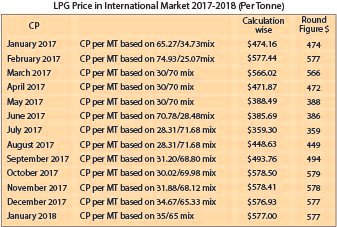
Price of LPG has increased US$200 every tonne over the past one year in the global market. But nothing has been done to adjust the price in domestic market. Consequently, operators have to supply LPG at cost price. Consumers Association of Bangladesh (CAB) claims that LPG is being supplied at higher price. While the attention of CEO Energypac, Humayun Rashid, was drawn, he said that it is still not possible importing LNG using large vessels due to shallow draft in the coastal area of Bangladesh. Transportation cost is increasing. Moreover, lack of transportation facilities also creating impediments. All these contribute to higher price of LPG at the users’ level. Taking all these into account, Dipon Gas is considering setting up large LPG storage facility. They are working on a 1,00,000 tonnes capacity LPG storage facility at Maheshkhali. They have plan for storing LPG in their floating storage after import and supply to operators. Feasibility study is also complete by now. TK Group is also working on a plan for setting up storage facility in collaboration with a Korean Company SK Gas. But it is not very clear when it can be operational.
About autogas, the government initially planned to stop gas supply to all CNG fuelling stations by 2020. LPG-depended gas market was thought to be expanded in phases. But the government has practically moved out of it. It is now being told that the two would coexist. CNG is paying the highest price of US$14 for every cubic meter of gas. Gas supply to CNG will remain profitable to the government even after importing LNG. Only 14 autogas supplying stations could be set up though it has been initiated much earlier. It has been learnt from discussions with operators that 50 autogas stations may be set up by the end of 2018. Experts believe that it won’t be wise thinking about rapid expansion of autogas market in gas franchise area. But Chief Executive of BM Energy Mohammad Nurul Alam thinks autogas would become popular even in gas franchise soon.
LPG market last year expanded to 7,00,000 tonnes -- 5% is used in industrial sector. But many users are compelled to use LPG due to the ongoing pipeline gas supply crisis. Humayun Rashid, CEO Energypac, said the government has launched program for 100 Special Economic Zones. LPG would get priority as alternative fuel there. Great enthusiasm has been created in northern Bangladesh for setting up LPG-based RMG and its linkages. He thinks pressure on pipeline supply of gas would be greatly relieved with expansion of LPG market. Use of LPG would continue to increase in industrial sector. But investors appear to be more interested in using imported LNG instead of LPG.
The energy ministry has pledged for supplying safe and environment-friendly fuel supply to all. The emphasis is on supplying safe fuel for cooking. Around 2.3 million families in Bangladesh are under pipeline gas supply network while 17 million families are using LPG for domestic affairs. The government aims to ensure supply of safe and environment-friendly fuel to all citizens by 2030. The works for using environment-friendly improved cooking stoves (ICS) is advancing steadily. It is expected that increased purchasing capacity would lead 60% population to using LPG by 2030. The LPG market will continue expanding. But the market development would be seriously impacted if the present and emerging issues are not immediately addressed in a coordinated manner. Users would turn their back if safety and quality-related issues are not promptly addressed.
As many as 16 different permissions and permits are required from different government agencies for initiating LPG business. Renewal of license also requires travelling along the same route. On top of it, BERC permission requires every time to import LPG. These involve time and cost. Cost of investment in local market is also significantly high. The government must introduce one point service for licensing and renewal. Navigability in rivers and waterways needs huge improvement. LPG carrying transports must get priority in ferries during road transportation.
The government should adopt some top priority programs for popularizing use of LPG as preferred fuel in industrial and commercial sectors. At the same time, for safe and environment-friendly use of LPG for cooking, a joint coordination and monitoring system of government and operators must be set up soon. The objective would be to ensuring safety and quality of LPG use. Finally, LPG must be available at competitive and affordable cost.