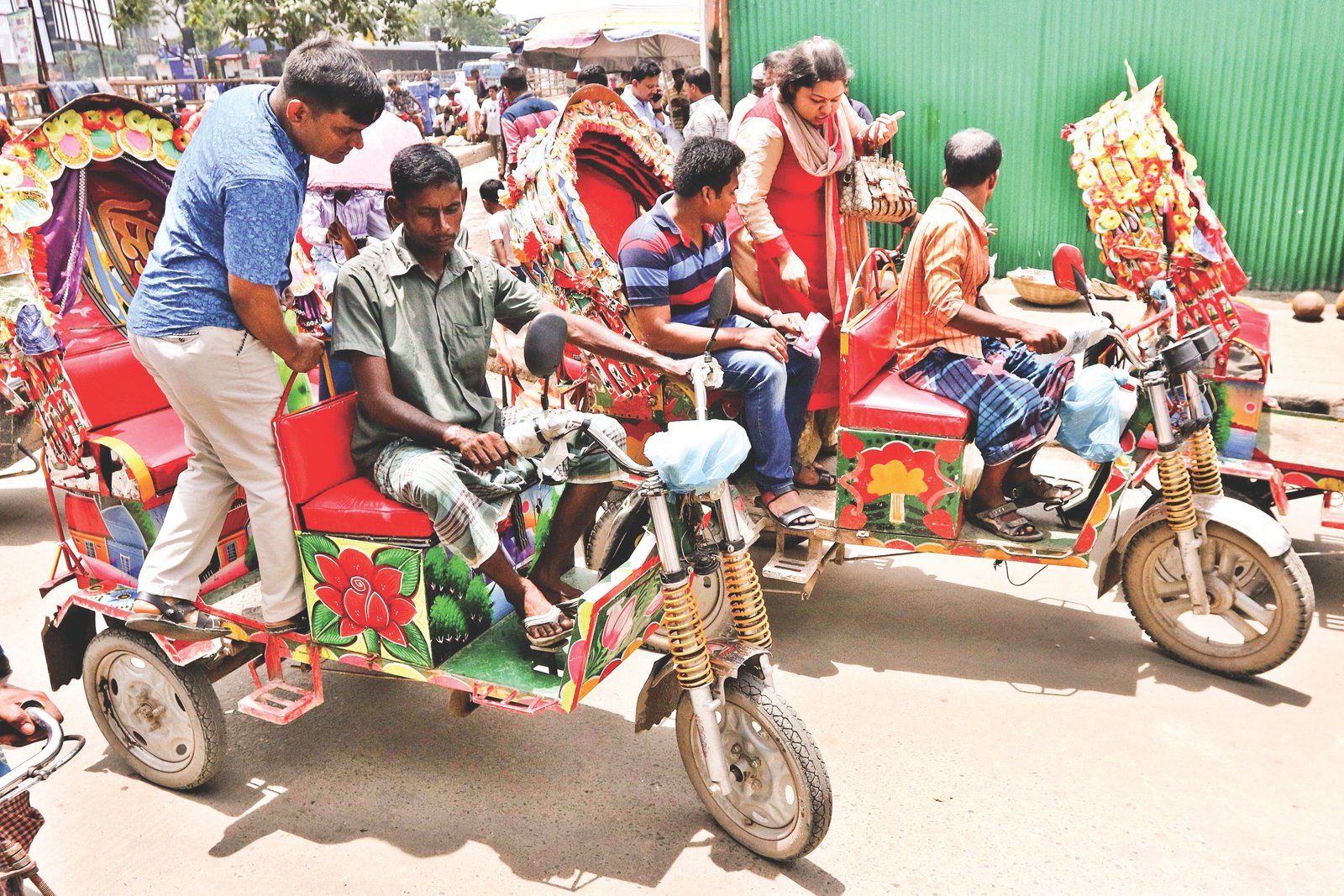
Battery-operated three-wheelers, commonly known as auto-rickshaws and easy bikes, have become a widespread mode of public transport across Bangladesh. These provide an affordable commuting option for millions of citizens, while serving as a vital source of livelihood for drivers and garage operators. However, their rapid expansion without structured regulatory oversight has introduced severe strain on the country's electrical grid and public infrastructure, including the environment. An estimated 5-8 million such vehicles currently operating nationwide consume roughly 5% or more of Bangladesh's total daily electricity generation.
The three-wheelers mostly use deep-cycle lead-acid batteries. Most of these vehicles use valve-regulated lead-acid (VRLA) types, while very few newer models and upgrades use lithium-ion alternatives.
The vast majority of the estimated 4-6 million three-wheelers run on lead-acid battery packs, which are typically 48-volt or 60-volt systems. Emerging options and modern upgrades utilize lithium-ion packs offering a longer lifespan and faster charging times. However, lithium-ion options represent a smaller market share due to high prices. Lead-acid batteries generally last 12-24 months, whereas lithium-ion alternatives can last 3-5 years with proper maintenance. Drivers frequently purchase trusted domestic and foreign brands like Hamko, Eastern, Rimso, Rahimafrooz, and Kijo.
In Bangladesh, the three-wheelers do not use a single large 48-volt or 60-volt battery unit. Instead, these run on a series connection of standard 12-volt lead-acid batteries. A typical deep-cycle tubular or VRLA battery (also known as a sealed lead-acid (SLA) battery) used in these three-wheelers (at 100-130 ampere-hour capacity) weighs approximately 30-38 kg per 12-volt unit. In standard lead-acid batteries, pure metallic lead and lead compounds account for about 60-65% of the total battery weight (with the rest being electrolyte liquid and plastic casings).
.jpg)
Used lead-acid batteries in Bangladesh rarely go to formal landfills because lead holds high commercial value. Instead, informal scrap dealers buy these old batteries, smash the plastic casings, open and dump the toxic sulfuric acid directly onto surrounding soil and into local water bodies. They then melt the lead plates over open-fire pits without any safety equipment or pollution filters. According to reports by the Daily Star, Bangladesh generates nearly 4,80,000 tons of lead-acid battery waste every year, with these three-wheelers accounting for over 60% of this local battery demand. The Daily Star further notes that around 80% of used lead-acid batteries in the country are processed through over 1,100 informal recycling sites, discharging millions of liters of untreated acid solution into rivers, canals and farmland. As documented in studies by Pure Earth and UNICEF, this uncontrolled recycling network releases vast amounts of lead into the environment, leaving approximately 36 million children in Bangladesh (about 60% of children) with elevated blood lead levels and causing severe environmental and long-term public health damage.
A full battery recharge takes approximately 6-8 hours using standard chargers. Millions of these vehicles rely heavily on informal or illegal grid connections for overnight charging. This practice draws thousands of megawatts of electricity and places significant stress on the national power grid.
To understand the energy scale required, each individual battery-operated three-wheeler consumes approximately 5-8 kilowatt-hours (kWh) of electricity per daily charging cycle- depending on battery age, depth of discharge, and vehicle capacity. Consequently, a baseline fleet of 5 million three-wheelers requires between 25,000-40,000 megawatt-hours of electricity every single day. Thousands of these vehicles undergo charging simultaneously during overnight hours, creating a sharp demand spike that heavily burdens local transformers and distribution lines. Ultimately, this practice leads to frequent voltage fluctuations and localized power outages.
The root of this grid instability lies in the vast gap between formal infrastructure and actual demand. Bangladesh currently has only about 3,300 legally registered charging points. In contrast, Dhaka alone hosts over 48,000 informal and unauthorized charging hubs operating out of residential garages and makeshift workshops. These uncontrolled networks rely heavily on illegal direct line connections, causing significant energy theft that deprives the Government of nearly Tk 4,000 crore in annual revenue. Furthermore, the majority of auto-rickshaws use low-grade lead-acid batteries and inefficient charging equipment that dissipate significant amounts of electricity as waste heat, worsening the strain on the national power supply.
Beyond energy consumption, the informal nature of this sector poses environmental, public health, traffic, and urban management challenges. Unregulated battery disposal and improper lead recycling contaminate local soil and water, exposing workers and communities to toxic heavy metals. At the same time, smart traffic cameras cannot track or enforce traffic laws due to a lack of official registration and standard license plates.
Addressing the impact of battery-operated three-wheelers requires a balanced strategy that preserves social benefits while protecting both the power sector and the environment. Establishing a formal policy framework to register every vehicle with traceable identification, alongside replacing illegal power hookups with designated solar-assisted or off-peak commercial charging stations, would substantially shield the grid. Transitioning the fleet from lead-acid batteries to energy-efficient lithium-ion technology would further optimize power use and eliminate illegal lead smelting and acid dumping while protecting soil, water, and public health. Through coordinated regulation, modernized charging networks, and technological upgrades, Bangladesh can convert these essential utility vehicles into a sustainable component of its national transport ecosystem without compromising energy security and the environment.
Colonel (retd) Engineer A R Mohammad Parvez Mazumder, afwc, psc
Download Article As PDF/userfiles/EP_V_24_07_Article_Parvez.pdf