1. EXECUTIVE SUMMARY
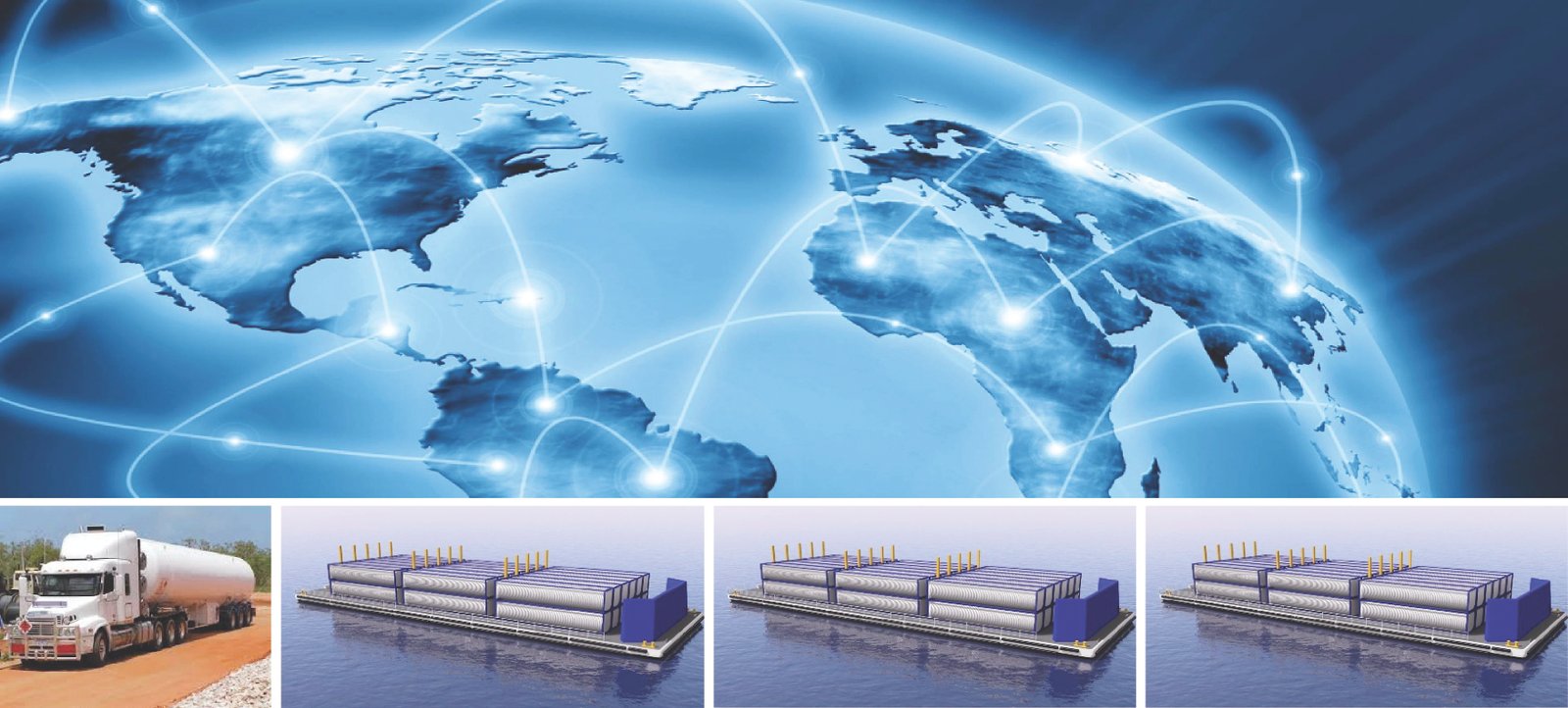
Bangladesh faces challenges in expanding its LNG supply due to limitations in FSRUs, offshore infrastructure, pipelines, and the country’s shallow-water conditions. One possible solution is LNG transported in cryogenic ISO tank containers and distributed by a “virtual gas pipeline”.
LNG can be loaded into 20- or 40-foot ISO tanks at the exporting country, shipped by conventional container vessels, and then distributed inside Bangladesh by truck, rail, or river barge. This system is often called a “virtual gas pipeline” because it can deliver natural gas to customers without constructing a continuous gas pipeline.
Recent reporting indicates that Bangladesh is exploring importing LNG from Malaysia in 20- and 40-foot ISO tanks for industries, power, and fertilizer plants. The concept deserves serious consideration as a complement to Bangladesh’s existing and planned FSRU and land-based LNG infrastructure.
The ISO-tank LNG “virtual gas pipeline” is not a substitute for Bangladesh’s large-scale FSRU and land-based LNG terminals. But at approximately 0.5–2 MTPA, it could become a valuable part of Bangladesh’s energy strategy.
The strongest concept is therefore a Distributed LNG Network combining ISO LNG tanks + conventional container vessels + ports + river barges + rail + trucks + regional LNG hubs + small regasification plants.
Such a system could bring LNG to industrial and power customers even when an FSRU fails. The most attractive feature may not be the lowest LNG price but a combination of speed, flexibility, geographic reach, lower infrastructure requirements, and supply security.
The immediate next step should be a detailed Bangladesh feasibility study covering:
1. Actual ISO-tank capacity and specifications
2. LNG supply source and purchase price
3. Port suitability at Chattogram, Matarbari, Mongla and Payra
4. Number and type of container vessels required
5. Rail, river-barge and truck logistics
6. Regional LNG hub locations
7. Small-scale regasification technology
8. Safety and regulatory requirements
9. Delivered LNG cost in $/MMBtu
10. A phased 0.5 MTPA → 1 MTPA → 2 MTPA development plan
Bangladesh should not try to replace or add FSRUs with ISO tanks. It should use ISO LNG to create a second, flexible “virtual gas pipeline” that complements the national LNG and gas-grid system.
2. How the System Would Work
The basic supply chain would be:
LNG supplier → ISO LNG tanks → conventional container vessel → Bangladesh port → truck/rail/barge → regional LNG hub → regasification → customer
The process would be:
a) LNG is loaded into certified cryogenic ISO tanks at the exporting country.
b) The ISO tanks are loaded onto a conventional container or cargo vessel.
c) The vessel carries the tanks to a suitable Bangladeshi port such as
Chattogram, Matarbari, Mongla, or Payra.
d) The containers are transferred to trucks, railway wagons, or river barges.
e) They are transported to regional LNG distribution hubs.
At the hub, LNG is transferred to storage and regasification facilities. The resulting natural gas is supplied through short local pipelines to nearby industries, power plants, fertilizer plants, or other users.ISO LNG containers can be transferred between ships, trucks, and rail, making the system particularly suitable for multimodal transportation.
3. An Important Limitation
ISO-tank LNG is not a replacement for Bangladesh’s large-scale LNG supply system. A national system requiring approximately 1,000–3,000 MMscfd cannot realistically be supplied entirely through ISO tanks. The number of containers, ships, cranes, trucks, storage facilities, and handling operations would become enormous.
Therefore, 1 MTPA is technically manageable, while attempting to transport 5–10 MTPA in ISO tanks would create a very large logistical operation.
Approximate requirements are:
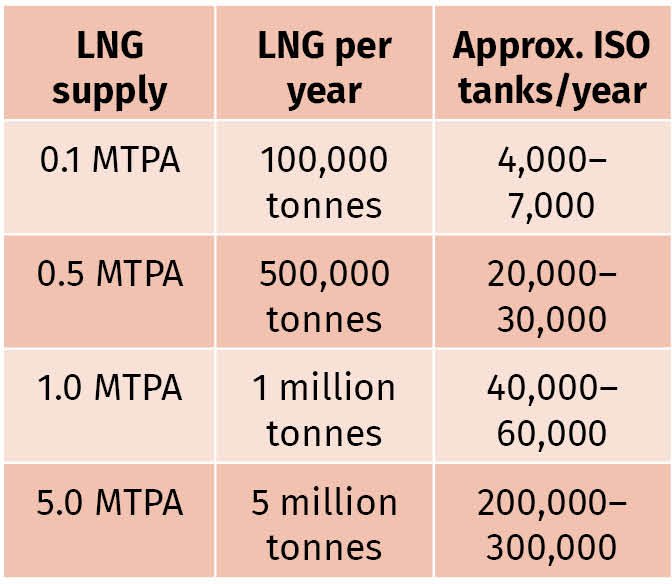
These figures are approximate and depend on the actual tank capacity and LNG density.
4. The Best Approach: A Hybrid LNG System
The question should not be: “FSRU or ISO tanks?” Instead, Bangladesh should consider a hybrid LNG strategy.
Layer 1 — Bulk LNG
Use FSRUs and land-based LNG terminals for national gas-grid supply.
- Large power plants
- Major fertilizer plants
- Large industrial consumers
- Dhaka and other major demand centres
Layer 2 — Small-Scale LNG
Use ISO-tank LNG for: - Industrial clusters without adequate pipeline supply.
- Fertilizer plants and Captive power plants
- Textile factories, Ceramic and glass industries
Layer 3 — Inland “Virtual Pipeline”
Use ISO tanks together with river barges, rail, and trucks to reach:
Khulna – Barishal - Rajshahi - Northern Bangladesh- Southwestern Bangladesh and Remote industrial areas
Three-layer approach allows ISO LNG to complement, not compete with large LNG terminals.
5. River Barges Could Be Particularly Important
Bangladesh has an extensive inland-waterway network. Therefore, the system should not depend entirely on road transportation.
Instead of: Port → Truck → Factory
A more efficient system could be: Receiving port → ISO LNG tanks → River barge → Inland LNG depot → Truck/Rail → Customer
Another possible route is: Payra → River barge/Rail → Barishal/Khulna region
Using barges could substantially reduce road congestion and transportation costs. Another important advantage, the LNG does not have to be transferred from an LNG carrier to an offshore FSRU. The LNG remains inside certified ISO tanks throughout the transportation process.
However, this does not eliminate port limitations. The receiving port must still have sufficient draft and infrastructure to handle the container vessel. The advantage is that Bangladesh would no longer require the specialized LNG-carrier/FSRU interface.
6. The Concept of a Distributed LNG Network
The most promising application for Bangladesh is therefore a Distributed LNG Network. Instead of bringing all LNG to a large terminal, LNG could be distributed among several regional hubs.
For example, a 1 MTPA system could initially be divided approximately as follows:
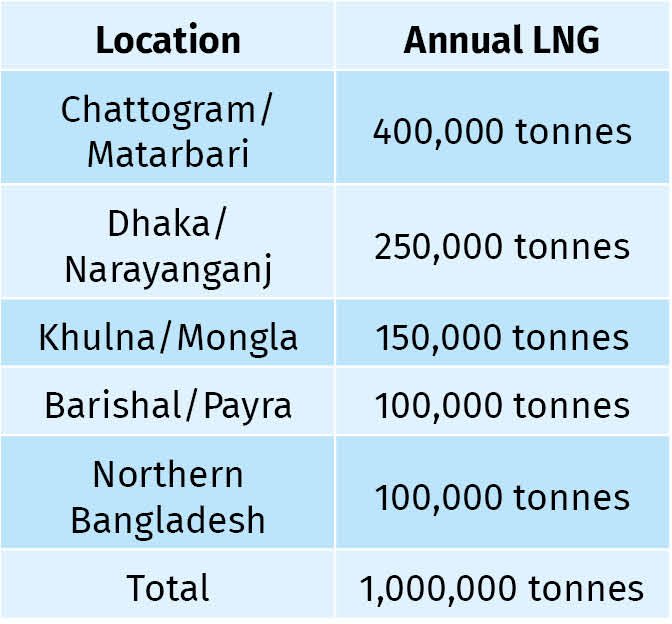
Each regional hub could include: 1. ISO-tank unloading facilities
2. Cryogenic LNG storage
3. Regasification equipment
4. Gas metering and Gas compression
6. Short pipeline connections to nearby customers
7. LNG truck-loading facilities
This modular system could be expanded gradually as demand increases.
7. A Bangladesh-Specific 1 MTPA System
A practical starting point would be a 1.0 MTPA ISO-LNG system, with the possibility of expanding it to 2 MTPA.
The proposed flow would be: Malaysia/other LNG supplier → 40-ft LNG ISO tanks → Container vessel→ Chattogram /Matarbari → LNG container depot → Rail/Barge/Truck → Regional LNG hubs → regasification →Customers
In short, it would function like a gas pipeline without requiring a continuous physical pipeline.
8. How Many ISO Tanks Would Be Required?
For planning purposes, the document assumes approximately 20 tonnes of LNG per 40-foot ISO tank. Therefore: 1,000,000 tonnes/year ÷ 20 tonnes/tank = 50,000 loaded tanks/year
This means approximately: 50,000 tanks per year- 4,170 tanks per month- 137 tanks per day
This is a substantial logistics operation, but it is not technically impossible. The actual number should be refined after selecting the specific ISO tank design, loading capacity, safety requirements, and operating procedures.
9. Natural Gas Equivalent
Approximately 1 MTPA of LNG is equivalent to about 130–135 MMscfd of natural gas.
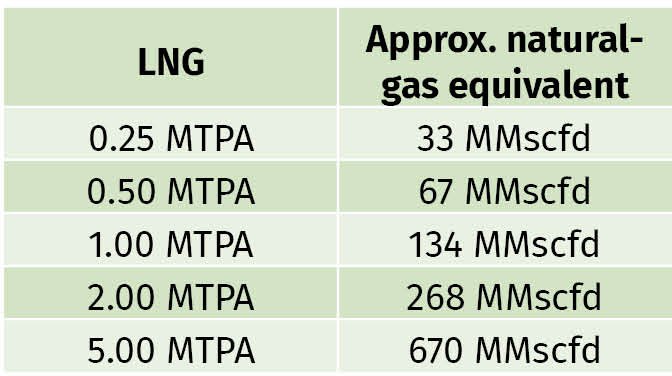
The proposal therefore suggests initially using ISO LNG for approximately 100–300 MMscfd of strategically distributed demand, rather than replacing the country’s entire FSRU capacity.
10. Proposed Five Regional LNG Hubs
Hub 1 — Chattogram/Matarbari: 400,000 tonnes/year
Potential customers: - Chattogram /Mirsarai industrial areas
- Fertilizer and Steel plants
- Ceramic industries
- Textile factories
- Power plants
Hub 2 — Dhaka/Narayanganj: 250,000 tonnes/year
Possible transportation: Chattogram → Rail/River Barge → Narayanganj
This could provide gas for industries without new pipelines for every industrial cluster.
Hub 3 — Khulna/Mongla: 150,000 tonnes/year
Possible transportation: Chattogram/Mongla → River Barge → Khulna
Hub 4 — Barishal/Payra: 100,000 tonnes/year
Possible transportation: Payra → River Barge/Rail → Barishal and surrounding areas
Hub 5 — Northern Bangladesh: 100,000 tonnes/year
Possible route: Chattogram → Rail → Dhaka → Bogura/Rajshahi/Rangpur.
This could provide LNG to regions where extending the high-pressure gas is difficult.
11. Transportation Strategy
Bangladesh should avoid relying entirely on trucks. A possible initial transportation mix:
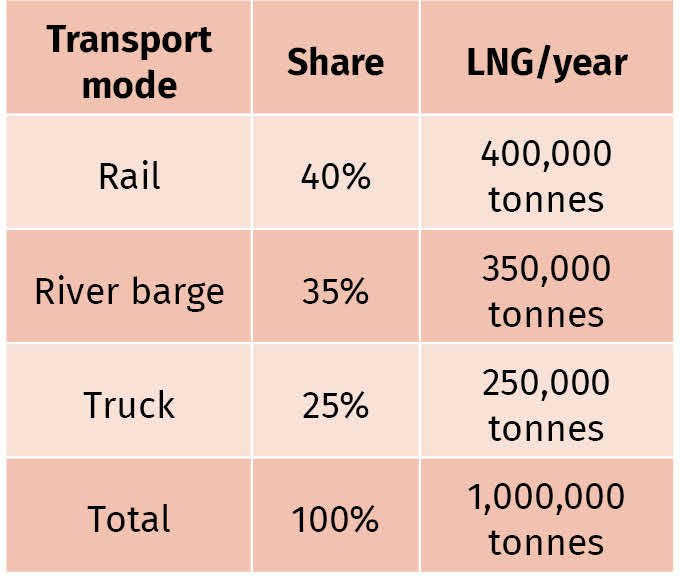
This approach would reduce dependence on highways and make greater use of Bangladesh’s rail and inland-waterway infrastructure. The exact percentages by a detailed feasibility study.
12. Container Vessel Requirement
For conceptual planning, assume that one container vessel can carry approximately 1,000 LNG ISO tanks, with each tank containing approximately 20 tonnes of LNG.
Therefore:1,000 tanks × 20 tonnes = 20,000 tonnes per vessel
For 1 MTPA:1,000,000 ÷ 20,000 = 50 vessel loads per year
This means approximately 4–5 vessel loads per month.
If larger vessels capable of carrying 1,500–2,000 ISO tanks are available and suitable for the selected port, the number of voyages could be reduced.
13. Indicative Capital Cost
The preliminary capital requirement for a 1 MTPA system could be approximately:
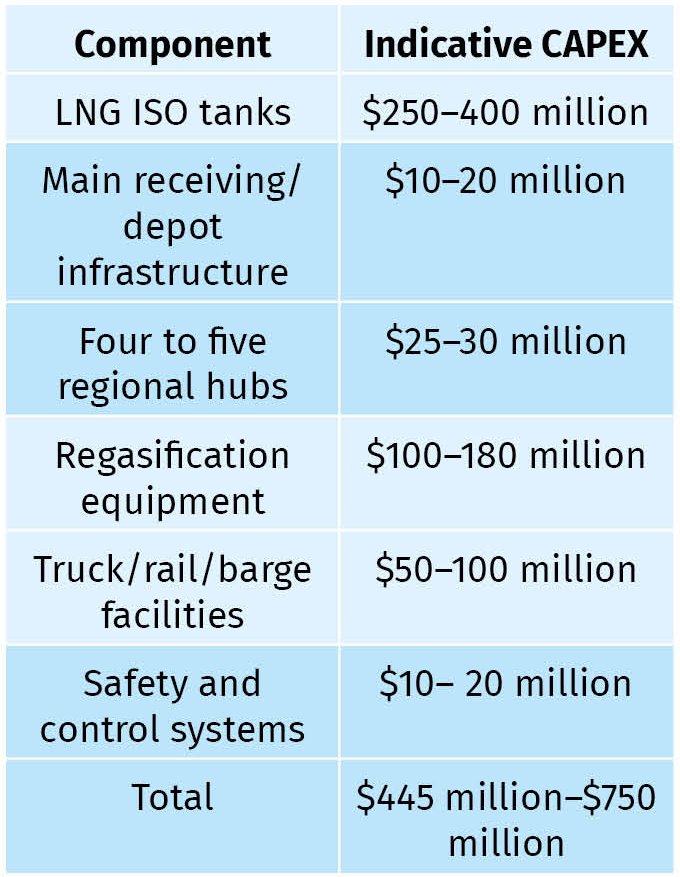
These figures are conceptual estimates only and should not be treated as EPC quotations. The ISO-tank fleet is a major investment, but the tanks can be reused for many years and could potentially be leased rather than purchased.
14. Economics: The Key Question
The most important question is the delivered cost of LNG.ISO-tank LNG will normally have higher transportation and handling costs than bulk LNG delivered through an FSRU.
The ISO-tank system can reduce the need for major infrastructure: - FSRU facilities
- Offshore mooring systems
- Subsea unloading pipelines
- Large LNG storage tanks
- Large regasification terminals
- Extensive transmission pipelines
One published analysis cited in the source material estimated landed ISO-LNG costs of approximately $7–9/MMBtu in a particular market. Bangladesh’s actual cost could be very different because it would depend on the LNG purchase price, shipping distance, port charges, container utilization, transportation costs, and regasification costs. Therefore, ISO LNG should not necessarily be judged only by its $/MMBtu cost.
Its other advantages are: - Lower initial infrastructure requirement
- Faster implementation
- Greater flexibility
- Ability to serve geographically separated customers
- Reduced dependence on large pipelines
- Better emergency and backup capability
- Greater supply resilience
15. Why This Could Be Valuable for Bangladesh
The main attraction of the virtual LNG pipeline is flexibility. A conventional gas pipeline requires a large investment before gas can reach the area. ISO LNG can be delivered wherever there is a suitable road, rail, or waterway connection and an appropriate regasification facility.
This could be particularly useful for industrial areas that are: - Outside the existing gas network
- Too far from major transmission pipelines
- Experiencing gas shortages
- Growing faster than pipeline infrastructure
16. Recommended Strategy for Bangladesh
Bangladesh should not view ISO-tank LNG as a replacement for FSRUs. Instead, the country should develop a complementary three-part LNG system:
1. Bulk LNG
FSRU and land-based LNG terminals for: National gas grid, Major power plants, Major fertilizer plants, and Large industrial consumers
2. Small-Scale LNG
ISO tanks + conventional container vessels for: - Industrial clusters
- Fertilizer plants and Captive power
- Textile, ceramic and glass industries
- Gas-short areas and Emergency supply
3. Virtual Gas Pipeline
ISO tanks + river barges + rail + trucks + regional regasification hubs for: Khulna, Barishal, Northern Bangladesh, Rajshahi and Remote industrial zones
This approach allows its LNG supply system to be built in stages instead of depending entirely on a few large facilities. The source document likewise recommends treating the ISO-tank network as a complementary system to FSRUs and land-based LNG infrastructure.
Zainul Abedin, P.Eng. (Alberta), Oil & Gas Engineering Consultant (Retired), SNC-Lavalin (Canada), Aramco (KSA), KOC (Kuwait), SCOP (Iraq)
Download Special Article As PDF/userfiles/EP_V_24_07_Special_Article.pdf