Southeast Asia Petroleum Exploration Society (SEAPEX), based in Singapore, is a non-profit organization formed with an objective to promote petroleum and natural gas exploration, development, and production in Southeast Asia. Every two years SEAPEX arranges a conference in Singapore which is one of the renowned and prestigious summits of oil and gas professionals in the Asia Pacific region. This platform promotes new concepts and technologies for finding, developing, and producing hydrocarbons. Moreover, the farmout session, which is an important integral part of this conference, allows investment opportunities for the industry stakeholders and govt. representatives. This year SEAPEX celebrated their ‘50th SEAPEX Conference’ at Fairmont Hotel, Singapore from 6 to 10 March, after four years of hiatus because of pandemic and other technical difficulties. This landmark event provided the opportunity to gather some 400+ energy professionals under the same umbrella from the Asia Pacific region. About fifty scientific talks were presented which covered all aspects of Geosciences in the energy transition, regional highlights, carbon capture storage (CCS), recent key discoveries, and tales of some great success. Consequently, there were twelve farmout presentations, where least-explored countries, e.g., Mongolia, Papua New Guinea, East Timor, Philippines showcased their prospects and opportunities; while countries having large mature producing fields, e.g., Malaysia, Indonesia and Australia attracted potential investment partners/buyers to step into their relatively complex and challenging petroleum prospects.
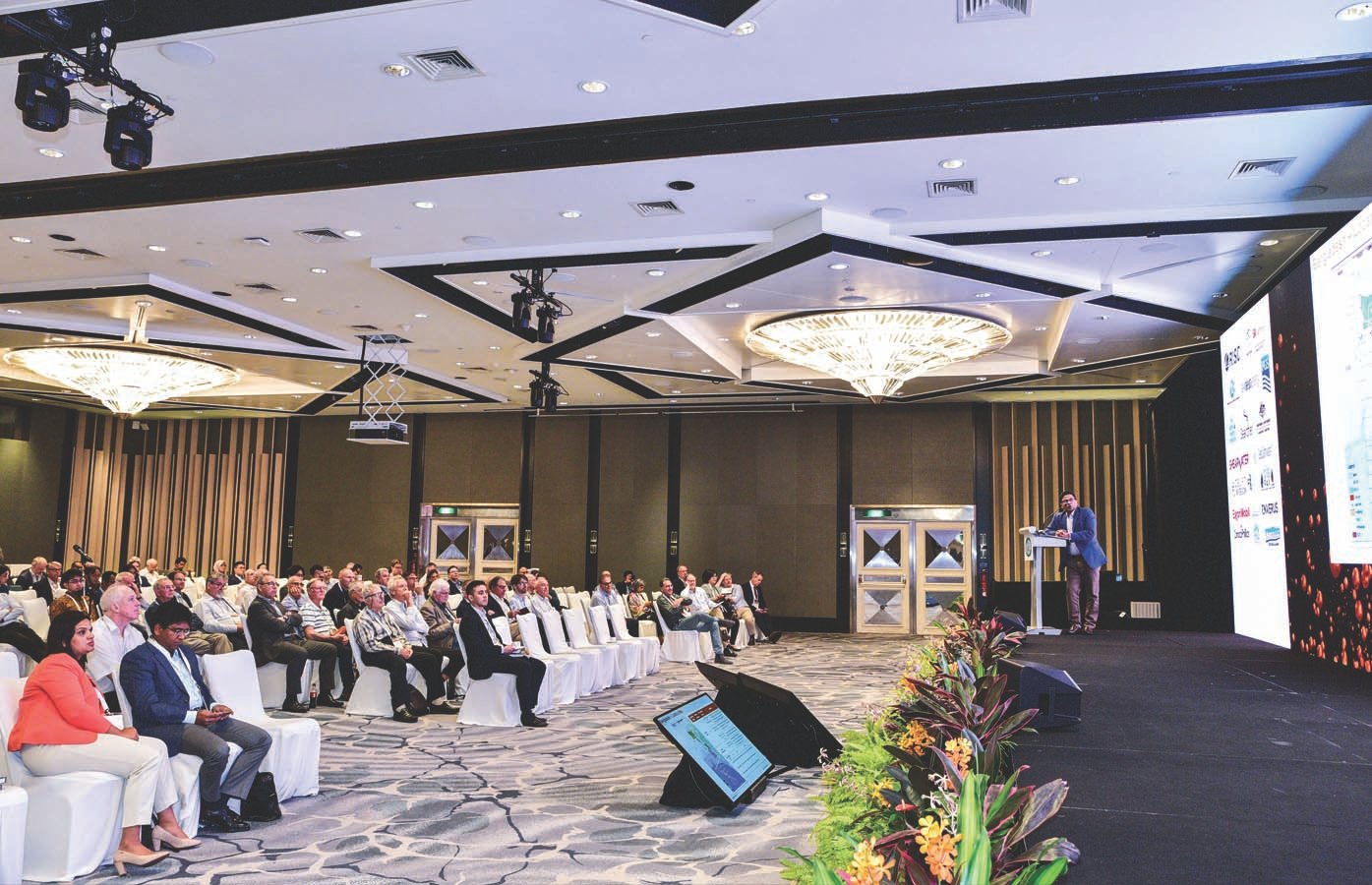
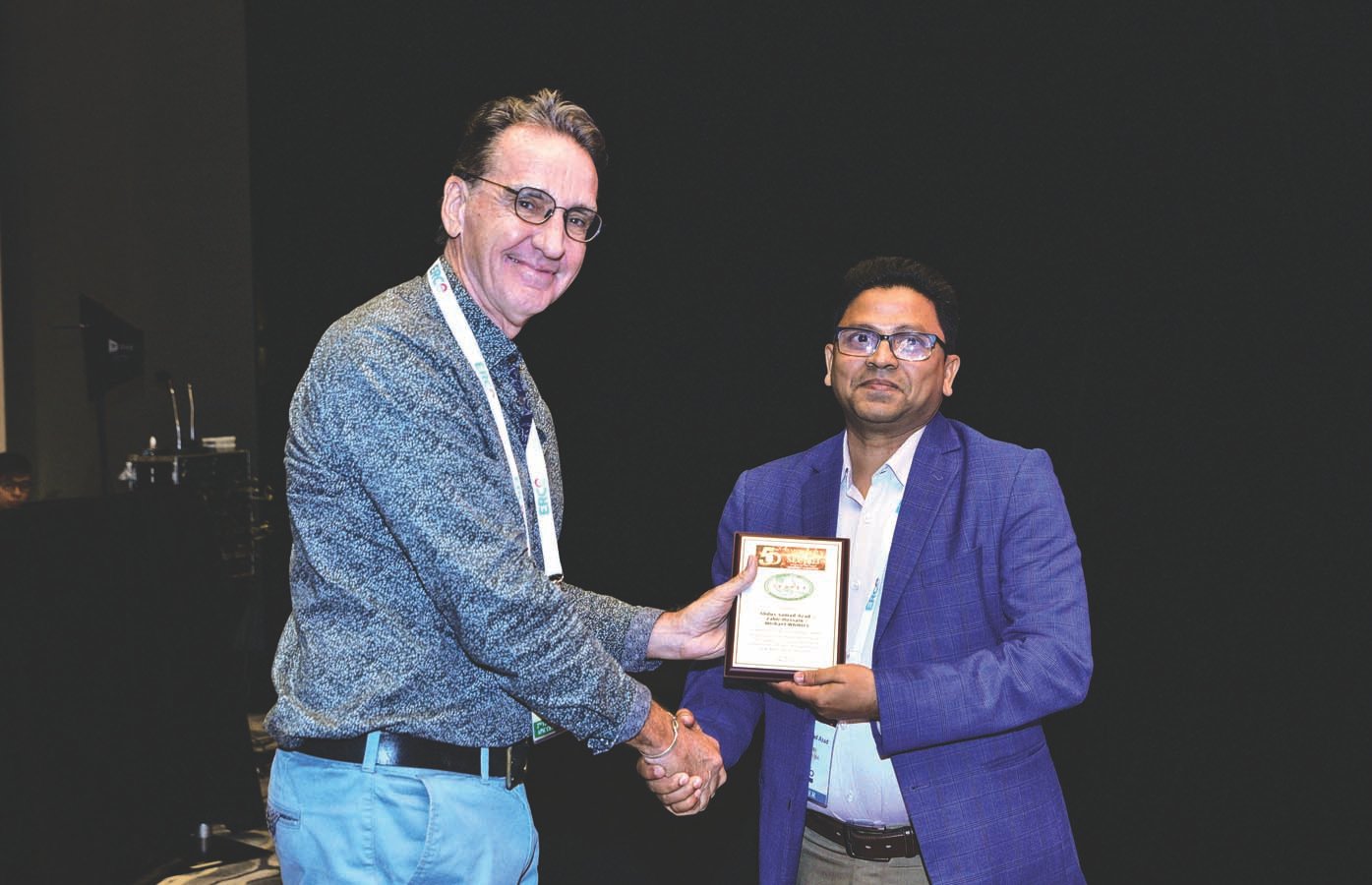
I made a presentation on behalf of my study team on ‘Hydrocarbon Potential of the Basin Floor Fan Complex (BFFC)’ (BFFC are deep-marine geomorphological features well known for occurrence of oil and gas) that we mapped in a southwestern shallow-sea block located in the Bay of Bengal (Photo-1). We also compared our findings with the recently discovered multi-Tcf ‘Shwe Gas Field’ in the Rakhine Coast, some 50 Kms southeast from the Myanmar-Bangladesh maritime boundary. We proposed that the elements which are required for successful hydrocarbon discovery are essentially present in our mapped area and many of these have close similarities with the discovered gas fields of the offshore Rakhine area, Myanmar. Our observations and findings caught sight of many industry stakeholders, potential investors and geoscientists who are interested in working in the Bay of Bengal. Many of them were eyeing the update of a multi-client seismic survey.
The long awaited multi-client seismic survey started in January 2023 and is expected to be completed by the first quarter of 2023. Although the final processing results are expected to be on board in the first quarter of 2024, the fast-track results will be available soon for early acreage evaluation. In addition, Petrobangla has now completed the draft of the proposed ‘Model PSC 2023’ and made it more attractive by replacing the ‘Profit Share Model’ to the ‘Revenue Share Model’ (Daily Star, 09 May 2023). The proposed ‘Model PSC 2023’ has been made more lucrative to the potential investors by reducing government share in ‘Profit Gas’ (i.e., the available gas quantity corresponding to the value required for royalty payments and the investor has taken the cost under the PSC terms) up to 15% (from 55 to 40%), by setting a capping free gas price (gas price set with Brent average crude price plus 10%, with an estimated average gas price of $ 10/Mcf), facilities in export of surplus gas, reduced mandatory exploration obligations, narrowing down the exploration benefits between deep and shallow sea blocks (Financial Express, 23 Jan, 2023). The draft model PSC is now waiting for the Prime Minister’s approval. All these positive signs are showing light at the end of the tunnel in future exploration opportunities in the Bay of Bengal.
After being back from the SEAPEX 2023 conference, we felt an urge to share our experiences and facts of the overwhelming interest from the audiences and potential investors. We believe this may stir up the long abeyance in exploration activities in the Bay of Bengal. We herewith present a comparative exploration history between the Bay of Bengal, Bangladesh and Offshore Rakhine, Myanmar; along with our scientific observation and findings among our interested readers and focus group connected to the oil and gas exploration industry.
Hydrocarbon Exploration History: The Bay of Bengal, Bangladesh and Offshore Rakhine Basin, Myanmar
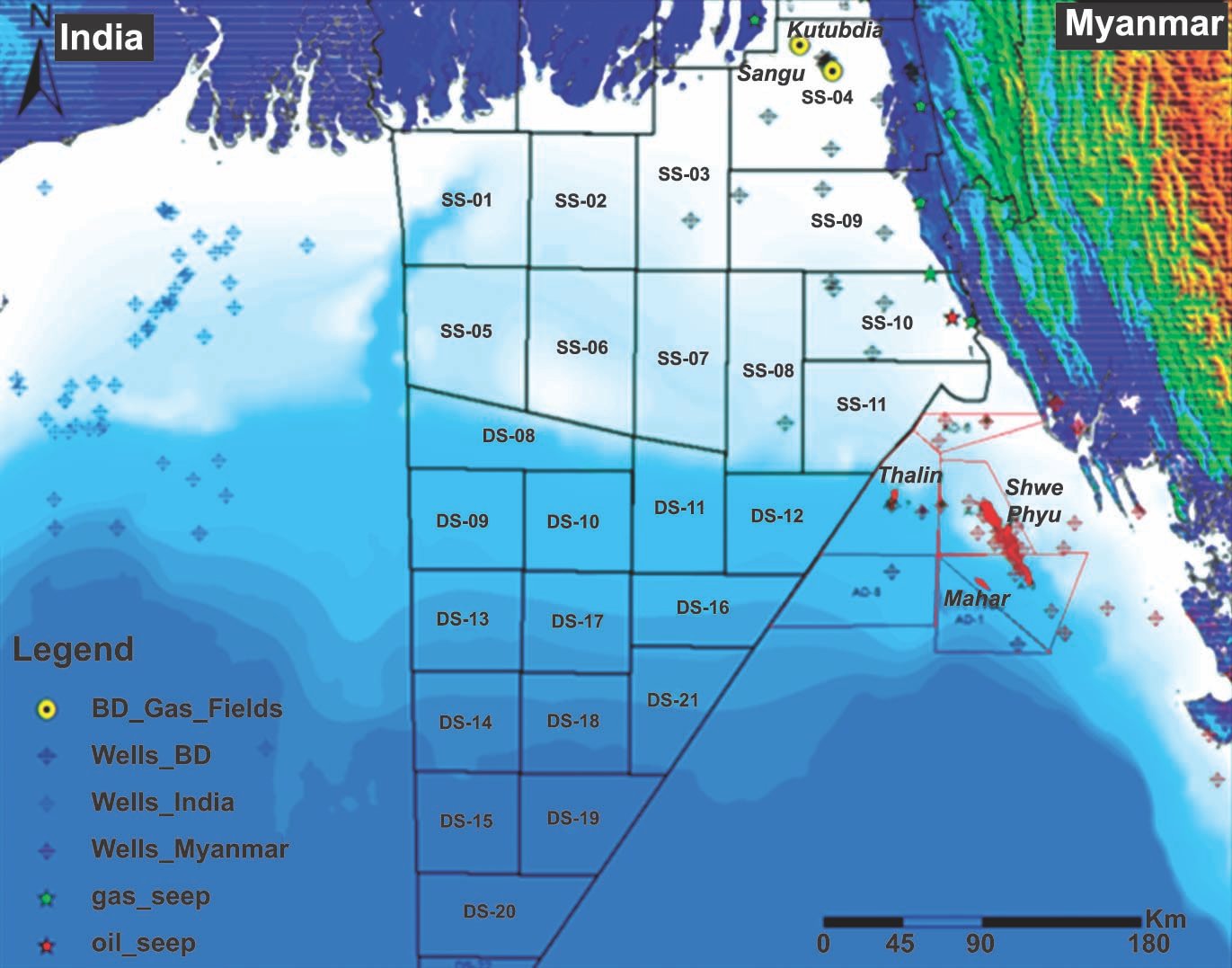
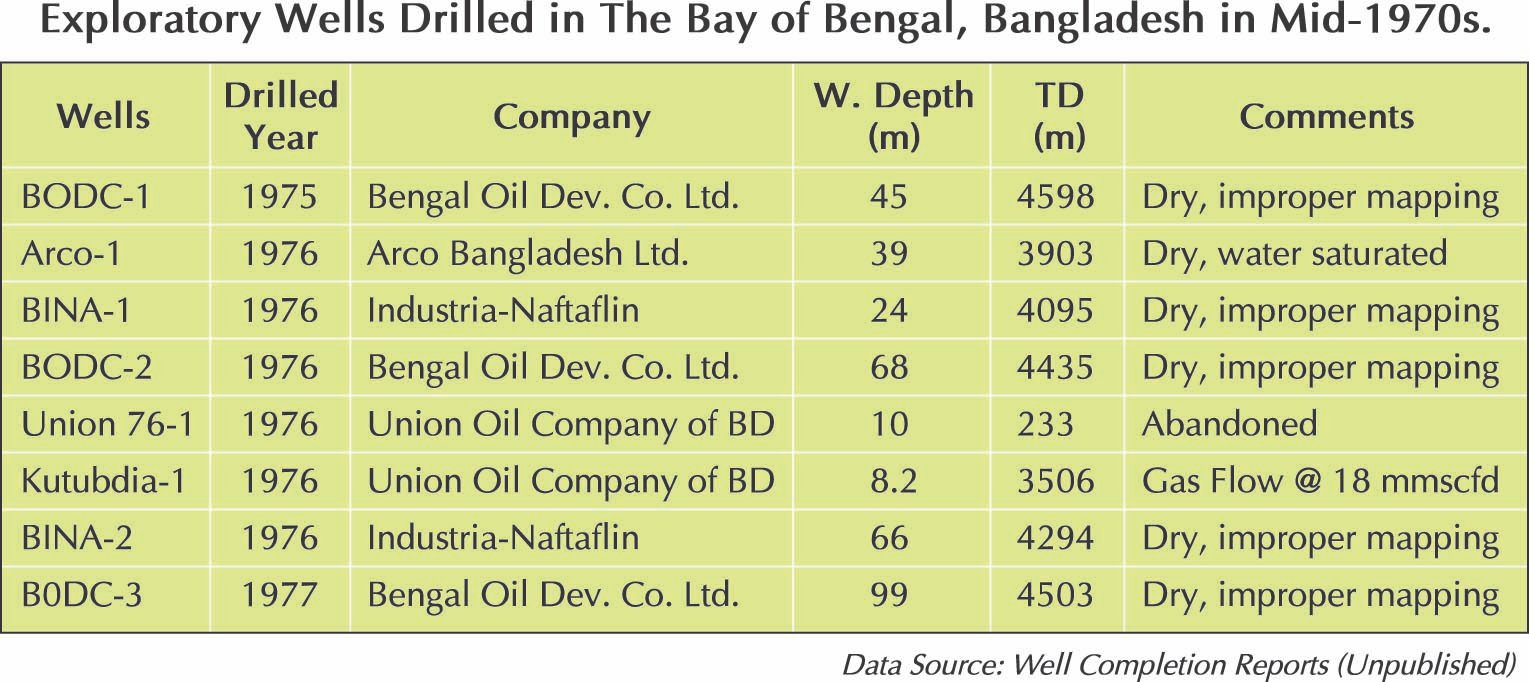
Oil and Gas exploration activities in the Bay of Bengal, Bangladesh and Offshore Rakhine Basin, Myanmar effectively commenced in the mid-1970s. Eight exploration wells (i.e., BODC-1, Arco A-1, BINA-1, BODC-2, Union 76-1, Kutubdia-1, BINA-2, BODC-3) were drilled in shallow water depth of the Bay of Bengal from 1974 to 1979 (Table-1). Among these, Kutubdia-1 (Fig. 1) was the first successful discovery made in January 1976. The well was drilled up to a depth of 3506m by Union Oil Company of Bangladesh (UOC) under Hatiya Block Production Sharing Contract (PSC), the first ever PSC made in the history of Bangladesh (Well Completion Report Kutubdia-1, 1977). Gas encountered at the depth range of 2660-2670m with a maximum flow rate of 18 mmscfd. At least two gas bearing zones at the depth interval of 2918-2938m and 3187-3200m were identified but no tests were attempted to confirm the productivity of these zones. Due to economic considerations and oil being the priority fluid during that time, UOC did not develop the well into production.
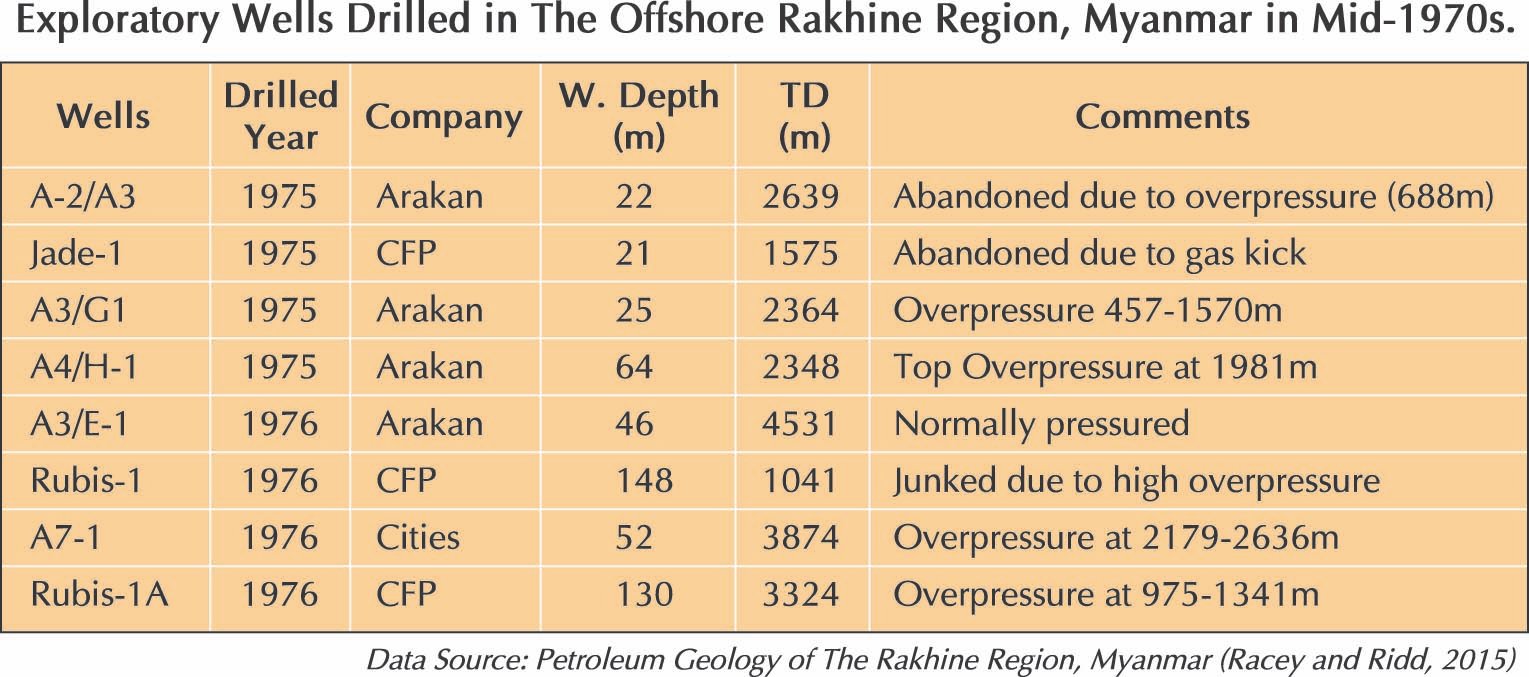
History of exploration activities in the Offshore Rakhine Basin (ORB), Myanmar was even more frustrating. Eight wells were drilled at contemporaneous time, and most of the wells were abandoned because of the drilling hazard related to overpressure (Table-2) (Racey and Ridd, 2015). Although the exploration wells were drilled intended to find oil-plays based on several onshore oil-seeps, in the Rakhine basin, no oil was discovered, a few wells were found with only gas shows (Racey and Ridd, 2015). Oil and gas exploration activities remained suspended both in the Offshore Bengal Basin (OBB) and Offshore Rakhine Basin till end of twentieth century.
In the early 1990s, Bangladesh Govt. signed a PSC with Cairn Energy and Holland Sea Search, a British-Dutch joint venture for oil and gas exploration in the then Block-16 and Block-15. ‘Sangu’ (Fig.1) the first commercial discovery in the Bay of Bengal was made by Cairn Energy in 1996. The gas field started to produce in 1998 and opened the new horizon of connecting offshore gas to the national gas grid. It was expected that further development of the Sangu Gas Field and succeeding offshore discoveries will bring glory and fortune to the country’s economy like many other oil & gas-rich countries in the world. However, the production dropped down suddenly from its peak production of 200 mmscfd to 35 mmscfd only after two years of its production. Although the initial estimated reserve of Sangu Gas Field was of TCF scale (GIIP 1.6 Tcf) (Cairn Energy, 1998), ~487 Bcf gas was produced. The production ceased in October 2013, due to an unexpected low reservoir pressure (Shahriar et.al., 2020).
However, this has never faded out the hydrocarbon exploration potential of the Bay of Bengal, rather provided with a lesson that offshore gas reservoirs are complex and requires a total understanding of the deep-marine settings based on large-scale regional 2D and high-resolution 3D seismic data coverage, proper analogue study, preparation of appropriate geo-models with advanced tools and technologies. Apart from Sangu, some sporadic exploration drilling activities, e.g., Sonadia-1 by Cairn Energy, Reju by Oakland International, Sandwip East-1 by Shell Bangladesh Ltd., Magnama-1 and Hatiya-1 by Capricorn Energy, Magnama-2 by Santos was carried out from 1998 to 2017. After more than two decades of the twenty-first century, the total number of exploratory wells drilled in the Bay of Bengal is only four, while considering the Sangu Appraisal (Sangu South) wells, the total number is less than twenty.
On the other hand, in the Offshore Rakhine Basin, Myanmar, drilling re-started in 2003, over 50 exploration and appraisal wells were drilled (Racey and Ridd, 2015). After drilling 20 unsuccessful wells, Korean company Daewoo discovered TCF-scale Shwe and Shwe-Phyu Gas Field in Myanmar Offshore Block A-1 (Fig.1), only fifty kilometers south-east from Bangladesh-Myanmar maritime boundary. Five unsuccessful wells were drilled in Block-A3 before the successful discovery of Mya Gas Field (Fig.1) (Racey and Ridd, 2015) was made. Vigorous and intriguing exploration activities and repeated unsuccessful endeavors from 2003 to 2014, eventually rewarded multi-Tcf gas discoveries in offshore Myanmar. Year 2012-2016 has been the golden period in the Myanmar oil and gas exploration history, when 28 billion US$ foreign investment were made (three-quarters of the total foreign investment made in the previous 22 years). In 2015, more than thirty IOCs were operating in 65 blocks under different Production Sharing Contract (PSCs). The gas production reached up to 1800 mmscfd, and 524 Bcf of gas were exported to Thailand and China in 2019-2020 (Geo Expro, Volume-6, 2022). The current gas production from Offshore Myanmar is about 1600 mmscfd with an estimated reserve of more than 20 Tcf. Mahar is the latest discovery made in the Offshore Rakhine Basin in 2020 by Posco, and the estimated reservoir being declared as 660 Bcf (Fig.1).
All this information clearly suggests that the Offshore Bengal Basin is not only the less explored area compared to Myanmar Rakhine Basin but also it is the least explored frontier in the world, although the basin has been considered petroliferous for a long time and attracted by many research scientists. Recent discoveries in the Rakhine basin along the Rakhine Coast just 50 kms south of Teknaf coast (Bangladesh) has now reconciled our thoughts to look into the similar geological features that resulted into successful discovery in Myanmar Rakhine coast and take robust exploration activities in the Bay of Bengal with immediate possible time.
Hydrocarbon Potential of the Basin Floor Fan Complex, Offshore Bengal Basin
We have studied a southeastern shallow water offshore block in the Bay of Bengal and found similar geological features which are proven hydrocarbon reservoirs in the ‘Shwe Gas Field’ of the Rakhine Basin, Myanmar. Among these, Basin Floor Fans (BFF) and its subsequent sand-rich feeder channels are of our particular interest. The BFF system is not only the proven hydrocarbon reservoirs in the offshore Rakhine basin, but also it constitutes significant hydrocarbon reservoirs all over the world, e.g., North Sea Basin, Norway; Gulf of Mexico, USA; Niger Delta, Gabon Coastal Basin, and Lower Congo Basin in west Africa; Mahanadi Basin, India. The BFF systems are geomorphic features formed under deep-marine settings and are usually complex in nature. Sediment deposition in these fan systems is controlled by factors related to continental shelf-slope settings, slope driven various sediment gravity flows, relative sea level changes, rate of sediment supply from source and subsidence, sediment transport direction, distance from source to sink, ocean bottom currents, ocean calamities like storms, cyclones, tsunamis etc. Proven hydrocarbon reservoirs of Shwe Fans, Myanmar have close similarities with the basin floor fans that we mapped in our acreage. Both the fans are part of the world’s largest submarine fan, i.e., Bengal Fan. The Himalayan hinterland (source of sediments) and feeding river-systems (proto-Ganges-Brahmaputra River system) are common in both the fans. The transport directions of sediments were also similar, transported from northwest to south-east. However, they have formed in different geologic time spans. Shwe Fans (Myanmar) are geologically younger (4 million annum) compared to the fans (6-8 million annum) that we mapped in our area.
For any successful hydrocarbon system five elements are very important: i) source rocks: normally fine-grained sediments with high organic content, ii) reservoirs: where the oil and gas remain stored once expelled from their source, iii) seals: which prohibits the reservoir gas to move further upward, iv) migration: the paths or conduits which help hydrocarbon to move from source to the reservoir and finally, v) traps: which are successful arrangement of all the four elements, from where oil and gas are tapped. If we compare the presence of all these elements in our mapped fans with the Shwe Fans, very close similarities can be observed.
Source Rocks: The source rocks of Shwe Gas Field and Bengal Fans are probably of similar organic rich Mio-Pliocene (5-20 million years old) sediments (shales). Biogenic gas (partial decomposition of organic matter in deoxygenated condition) generated from these organic rich shales are reservoired in Shwe sandstone fan reservoirs. We expect both biogenic and thermogenic (complete decomposition of organic matter with increased subsurface temperature and pressure) gas in our fan reservoirs. This is because of the evidence of both thermogenic, biogenic or mixed gas in the neighboring gas fields of Bay of Bengal, e.g., thermogenic gas (Type-III, Kerogen) in Sangu; mixed (thermogenic & biogenic) and biogenic in Shahbazpur Gas Field. In addition, gas shows in all the vintage wells drilled in the Bay of Bengal and several gas and oil seeps (in Saint Martin’s Island, only 60 km north-east) in the neighboring areas (onshore & offshore) suggest that an active petroleum system is prevailing in the Bay of Bengal.
Reservoirs: Occurrences of good quality gas reservoirs in the mud-rich Bengal Fan has always been a challenge because of its enormous distance from the source (the Himalayas) to the sink (Bay of Bengal) and vast areal extent (largest submarine fan in the world). However, we presume moderate quality reservoirs with a pore space percentage (porosity) of about 10% may exist in the fine-grained sediments. There are many instances in the world where such fine-grained, thin-bedded turbidite sediments worked as prominent oil-gas reservoirs. Moreover, lateral extension of such types of reservoirs is huge. Shwe fan reservoirs may have better reservoir quality compared to our mapped fans as it encountered east-west sediment dispersal systems in the later part of the geological age (2 million years ago) which were sandier and have shorter distance (derived from Arakan Mountains). However, our fans may have larger lateral and vertical extent thus may encounter larger reservoirs.
Seals: Laterally extensive impermeable clay layer usually acts as a seal in the hydrocarbon play system which holds the gas in the reservoir thus prohibits further migration. We have mapped plenty of such laterally extended impermeable clay layers of 1-2 million years old. Moreover, the laterally extensive regional clay layer (popularly known as Upper Marine Shale, UMS) may also act as seal, as this represents a basin-wide seashore movement towards land about 5 million years ago.
Gas Charge and Migration: Gas expulsion from fine-grained source rock and migration to porous and permeable reservoirs is another important component for successful occurrence of oil and gas. In the subsurface image maps (seismic sections) we have plentiful evidence which shows vertical gas migration (gas chimney) in our acreage. Moreover, some of the large faults (basement-controlled displacement of sedimentary layers) can act as conduits to migrate this gas into the reservoir.
All these geological features and characteristics evidently prove that the Bay of Bengal has excellent opportunities and should be brought into immediate initiatives for hydrocarbon exploration activities. Moreover, results from multi-client seismic survey, government initiatives in easing PSC clauses are the new avenues to investigate things in a more positive way.
Certainly, these are the third stage exploration targets and involve potential risks. However, this has been the worldwide exploration practice, and we should step forward to meet the ever-increasing energy demand and to pacify the economic crisis involved in importing expensive fuels from abroad.
Click Here to Download Cover as PDF/userfiles/Article_20_24_Hydrocarbon Potential in the Bay of Bengal_New Glimpses from SEAPEX 2023 Conference_Abdus Samad Azad_Zabir Hossain.pdf
Abdus Samad Azad, Ph.D., Geological Manager1 & Zabir Hossain, Geophysical Manager1
1KrisEnergy Bangladesh Limited, NB Tower, 40/7 North Avenue, Gulshan-2, Dhaka-1212.